
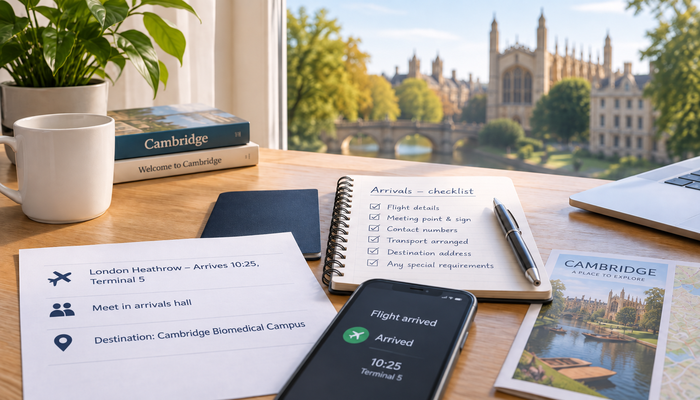
Somewhere over the Atlantic right now, a visiting researcher is trying to work out how to get from Heathrow to Cambridge. They have a hotel name, a meeting at nine tomorrow morning, and a phone that may not connect as expected when they land.
For hosts arranging visits by researchers, speakers, collaborators, interview candidates, new hires or conference delegates, the visit itself is usually planned carefully. The journey from the airport is easier to overlook. It may be arranged at the last minute, left to the visitor, or based on the assumption that they will work it out when they arrive.
Usually they do. But those first hours can shape the visitor's first impression of the whole trip. Here are the points worth planning in advance.
Before they fly: check the paperwork, not just the flight
Since 25 February 2026, the UK has enforced digital permission to travel for non-visa nationals. Visitors travelling on passports from countries such as the United States, Canada, Australia and EU countries other than Ireland will usually need an approved Electronic Travel Authorisation (ETA) before travelling, unless they are exempt or already have the relevant UK immigration permission. Airlines can prevent boarding where the required ETA, eVisa or other valid documentation is missing.
Visitors from other countries may need a visa instead, so it is worth directing them to the official GOV.UK visa and ETA checker well before travel.
A short note in an invitation email can prevent a much bigger problem later. GOV.UK also warns that other websites may charge more to apply. The official application route is through GOV.UK or the UK ETA app.
"Flying into London" can mean very different onward journeys
For some visitors, the train is a perfectly good option. Stansted Airport has direct trains to Cambridge. Gatwick, despite being on the far side of London, also has direct Thameslink services to Cambridge, so changing trains in central London is not always necessary.
Heathrow is different. Its direct rail services run into London, so continuing to Cambridge requires an onward connection. Heathrow's own rail information explains the Heathrow Express, Elizabeth line and Piccadilly line options into London.
London City Airport has no National Rail station and connects through the DLR. Luton Airport connects to Luton Airport Parkway by the DART shuttle. The National Rail guide to London airports is a useful place to check these onward connections.
The destination within Cambridge matters too. Cambridge South station opened on 28 June 2026 next to the Cambridge Biomedical Campus. Greater Anglia lists direct services from both Stansted Airport and Gatwick Airport. The station has pick-up and drop-off facilities, but no taxi rank, so anyone who needs a vehicle for the final part of the journey should plan that in advance.
So when a visitor asks which airport to book, the answer depends on more than the airfare. Their final destination, luggage, arrival time and confidence with the onward journey all matter. A direct train may be ideal for one traveller, while another may reasonably prefer a pre-arranged transfer after a long flight or when travelling with more luggage.
Landing time is not arrival time
Touchdown is the start of the arrival process, not the end of it. Taxiing, border control, baggage reclaim and finding the correct exit all take time, and the total can vary considerably from one journey to another.
That is why a pickup should not rely only on the scheduled landing time. If you are arranging a transfer, ask whether the operator monitors the flight and how waiting time is handled if the passenger takes longer than expected to come through arrivals.
Plan for a phone that does not work as expected
It is easy to assume the visitor will simply call after landing. In practice, roaming may be disabled, a travel eSIM may not have activated yet, or the phone battery may be low after a long journey.
Agree the meeting arrangements in writing before departure: where the traveller will be met, what name will appear on any sign, and which contact number or messaging method should be used if something changes.
"Cambridge" is not an address
A destination described casually as "Cambridge" might actually mean the Biomedical Campus, West Cambridge, Cambridge Science Park, Granta Park, Babraham, the Wellcome Genome Campus at Hinxton, a college, a hotel or a private address. These are very different destinations when somebody is planning the final part of a journey.
College accommodation can bring its own practical questions: which entrance to use, where a vehicle can stop, and whether somebody will be available to let a late-arriving guest in. Share the full destination, the correct entrance where relevant, and any late-arrival instructions before the visitor travels.
Decide who owns the arrangement
The person who books the journey is often not the person taking it. A department administrator may organise the transport, another colleague may be expecting the guest, and only the visitor actually meets the driver.
When a connection is missed or a flight changes, information can easily end up with the wrong person. Keep both the organiser's details and the traveller's on-day contact details with the booking, and make sure somebody else knows the plan if the main organiser is unavailable.
When being met in arrivals is worth it
For a confident, frequent traveller, a clear pickup point may be all that is needed. For a first-time visitor to the UK, a keynote speaker, a family with young children, or somebody arriving after a long-haul flight, being met in the arrivals hall with their name clearly displayed can remove a lot of uncertainty.
It is a judgement call. The useful question is not whether meet-and-greet is always better, but whether the extra reassurance is worthwhile for that particular visitor and journey.
A short pre-arrival checklist
- ETA or visa requirements checked well before travel
- Airport chosen with the onward journey and final destination in mind
- Flight number, terminal and scheduled arrival time shared with whoever is arranging the collection
- Meeting point, sign name and contact method sent to the traveller in writing
- Full destination address, including the correct entrance and any late-access arrangements
- Passenger and luggage numbers confirmed
- Both the organiser and the traveller identified as contacts where appropriate
- A named person on the host's side who knows the plan
The airport journey is rarely the reason anyone comes to Cambridge. But it is the first part of the visit they experience, and one of the easiest parts to make clear and predictable with a little planning.
Petre Croitoru is the founder of Fleeyo, a Cambridge-based airport transfer company. Fleeyo regularly arranges airport journeys for visitors travelling to and from Cambridge.