
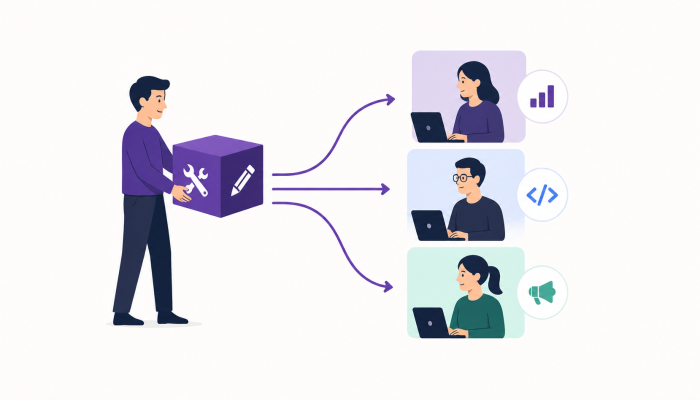
Generalists are often the reason a startup gets moving. They are not always the people who can carry every function through scale.
Early startups need generalists.
They need people who can move between customer calls, product feedback, sales support, hiring, operations and whatever else is on fire that week.
That flexibility is a strength.
But as the company grows, the work changes. The problems become deeper. The stakes become higher. What used to need energy and adaptability now needs technical depth, repeatable systems and specialist judgement.
The generalist trap happens when a startup keeps hiring for flexibility long after the business needs depth.
The role that got you here may not get you there
In the early stage, a strong generalist can cover a surprising amount of ground.
They can launch a basic campaign, manage early customers, build a rough process and keep momentum moving.
But scale exposes gaps.
- A broad marketer may not be able to build a serious attribution model.
- A product-minded operator may not be ready to lead revenue operations.
- A strong engineer may not want to manage a growing team.
- A founder may keep hiring people who can “turn their hand to anything” instead of solving the specific capability gap.
None of this means generalists are less valuable. It means the company needs to be honest about what the next stage requires.
Generalists create range. Specialists create depth. Scale-ups need both, but not by accident.
Know when the specialist moment has arrived
The specialist moment usually appears before founders want to admit it.
The signs are practical:
- quality drops because one person is covering too much;
- the team keeps solving the same problem manually;
- a function becomes too complex for founder oversight;
- results plateau despite effort increasing;
- decisions need deeper expertise than the current team has.
This is when hiring criteria need to change.
The question is no longer, “Can this person help across lots of areas?”
The better question is, “What specific capability does this person add that we do not already have?”
If the role exists because the company has outgrown improvisation, the interview should test depth, not just adaptability.
Do not turn specialists into silos
The answer is not to replace every generalist with a narrow expert.
Startups still need people who can work across ambiguity, collaborate outside their function and understand the wider business.
The strongest hires are often T-shaped: deep in 1 area, broad enough to work well with others.
A good interview process should test both sides:
- Depth. Can they solve the specialist problem properly?
- Judgement. Can they explain trade-offs clearly?
- Collaboration. Can they work across teams without creating silos?
- Adaptability. Can they operate in a changing startup context?
- Impact & contribution. Will they raise the standard of the team around them?
This is where a clearer startup hiring process matters. Without structure, teams can confuse impressive breadth with the specialist evidence the role actually needs.
Protect your early team through the transition
Adding specialists can feel threatening to early employees.
People who helped build the company may worry they are being replaced, narrowed or judged against a new standard.
Founders need to handle that carefully.
The message should not be, “Generalists are no longer useful.”
The message should be, “The company is entering a new stage, and we need clearer ownership, deeper capability and better support around the people already here.”
Some early generalists will specialise. Some will move into leadership. Some will remain valuable connectors across functions.
The risk is not having generalists. The risk is having no clear plan for how roles evolve.
Where Maslow fits
At Maslow, we are building the Interview Operating System for structured interviews, clearer interview evidence and better-informed hiring decisions.
For startups moving from generalist-heavy teams to specialist depth, the key is evidence. Hiring teams need to know what they are testing, what strong answers look like and how each candidate will contribute to the next stage of the company.
Maslow is designed to help teams prepare better interviews, ask better questions and capture decision-ready evidence while keeping human judgement central.
Further reading
For a longer version of this article, read Maslow’s full piece on avoiding the generalist trap in startup scaling.
Hire for the stage you are entering
Maslow is currently opening early access for startups and hiring teams that want to run more structured interviews, capture clearer evidence and improve hiring confidence while keeping human judgement central.
The goal is not to stop hiring adaptable people. It is to know when the company needs specialist depth, and to assess that depth properly.