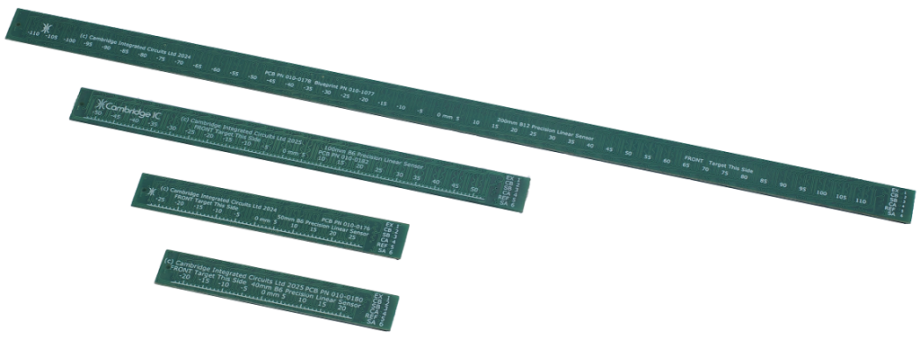
The new sensors incorporate special coil designs from CambridgeIC. Currently available designs support measuring lengths of 40 mm, 50 mm, 100 mm, 150mm and 200 mm. Each sensor coil includes an excitation coil to energize the target, coarse sensor coils to establish absolute position, and fine sensor coils for precision and accuracy.
A distinctive feature of the technology is that customers can manufacture sensors themselves using designs provided by CambridgeIC, helping to reduce manufacturing costs. The sensors detect the position of a moving, contactless target, which itself is also a PCB containing a resonant circuit with a printed coil and resonating capacitor(s). By making the target resonant, the system generates far stronger signals than conventional non-resonant inductive sensors—enabling high resolution, high accuracy, large operating gaps, and no need for calibration.
Signal processing is handled by CambridgeIC’s CAM622 Resonant Inductive Position Encoder IC. The CAM622 provides:
- SPI interface, delivering typically 1 μm noise-free resolution and full absolute position
- Quadrature ABN interface, configurable down to 2 μm AB edge resolution
- Newly announced BiSS-C interface support (BiSS is a trademark of iC-Haus GmbH).
With these features, CambridgeIC’s Type B linear sensors offer the speed and resolution of optical encoders, but at a lower cost and with greater robustness and environmental immunity. Embedding the sensors and targets in a customer's product is straightforward, requiring only normal engineering tolerances and no special alignment.
Unlike magnetic linear encoders, Type B sensors provide full absolute sensing at power-on, operate with small track widths, and the target does not attract magnetic swarf.
Key applications include:
- High-speed closed-loop motion control
- Linear motor feedback and commutation
- Valve position sensing
- Steering rack position sensing in vehicles
- Replacement of optical and magnetic position encoders
Visit us at SPS 2025 from November 25 to 27, Hall 4 Stand 174, and see the new sensors in action!
Customers can purchase sample Type B Linear Sensors, Targets, Sensor Connecting Cable part 013-6021, and CAM622 ABN Bundles for evaluation purposes.
CambridgeIC, founded in 2007, develops processor ICs for resonant inductive sensing technology. The team has been pioneering this technology since 1994 and today serves a wide range of customers in industrial, medical, and automotive applications, including market leaders in their fields.