A London company's decision to ask candidates for a video rather than a CV raises a question that goes beyond one recruitment process.
If AI can help someone produce a fluent CV, a polished cover letter or a convincing application answer, what does that document still prove?
Employers have relied on CVs and interviews because they are practical: they turn a large number of applicants into a smaller number of conversations. They have never been perfect, but they have usually given employers something to read, question and compare.
What has changed is the confidence they carry. A CV used to show how a person chose to describe their experience and connect it to an opportunity. It was a partial picture, but one an employer could read as the candidate's own work.
AI has made that harder to assume. The application may still be accurate and may still reflect the candidate's real experience. The difficulty is that the employer has less reason to know how much of the thinking belongs to the person submitting it.
The scale of the shift is becoming visible. Prospects at Jisc's Early Careers Survey 2026 found that 73% of students and graduates had used AI at some stage of an application process, up from 55% the previous year. Nearly half, 46%, had used it to write a CV or cover letter.
Employers are noticing the same problem from the other side. The Institute of Student Employers' Student Development Survey 2026, based on data from 144 employers, found that employers were concerned candidates may misrepresent their abilities when using AI in selection processes: 67% for graduates and 66% for school and college leavers.
The problem is practical rather than moral: candidates are using tools that are now widely available, and employers are trying to work out whether the evidence in front of them still means what it used to.
The deeper question is what evidence employers will trust when familiar forms of evidence become easier to produce.
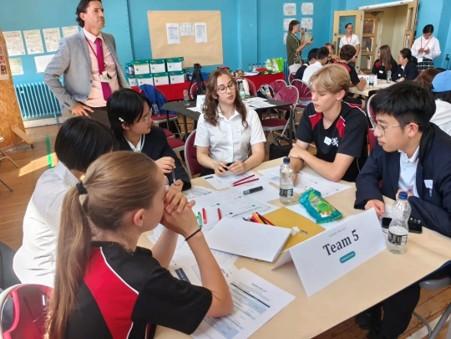
In CognateUK's early programme design and student-facing activity, this has made us pay closer attention to the material around the finished work. In one recent learning activity, students were asked to develop ideas in response to a real human need. The final ideas mattered, but they were not the most interesting part. The more useful evidence appeared when students listened to feedback, changed direction, explained what they had misunderstood and showed why their thinking had moved.
That kind of evidence is often present while learning is happening. Then it disappears.
What remains is the finished essay, the final presentation, the portfolio entry or the application answer. Those outputs still matter, but they may no longer be enough on their own.
What matters more is whether a student can explain why they used AI in a particular way, show what they accepted, questioned or rejected, and describe how feedback changed their thinking. It also matters whether they can name what they still do not know, and respond when someone challenges their reasoning. These are harder things to fake than a polished paragraph. They are also closer to the qualities many employers say they value.
A student at a recent session connected to the Cambridge innovation ecosystem asked how talent is actually spotted. What followed was less about grades than about curiosity, willingness to try, and the confidence to engage with unfamiliar problems. None of those qualities is easy to evidence through a conventional application form.
Bright Network's What do graduates want? 2024/25, based on responses from more than 14,000 of its student and graduate members, gives a useful example. Employers ranked resilience as the second most important quality in a graduate; students thought employers placed it eighth. Whether every employer means the same thing by resilience matters less than the gap itself.
Changing the application format will only take employers so far. A video may feel more human than a CV. It may show more of how someone presents themselves and briefly make fabrication harder. It still captures a performance at one moment in time.
This matters especially in sectors such as technology and life sciences, where early-career staff may work with specialist knowledge long before they carry full responsibility. What employers need there is judgement about when a polished answer is not enough.
I do not think we yet know whether AI is changing human capability itself, or whether it is first changing our ability to recognise capability.
If the evidence employers most need is created during learning but lost by the time recruitment begins, how should those of us designing learning begin to capture it more thoughtfully?
Editorial note: This article reflects working perspectives developed through the practice of CognateUK, an initiative of Excellence First Enterprise Consultancy, and is intended to support informed discussion. It does not constitute advice or represent the official positions of any affiliated organisations or partners.
Image: Students developing ideas during a CognateUK learning activity.