Across education systems worldwide, leaders face a familiar dilemma. Significant challenges—student disengagement, teacher workload, uneven wellbeing—are often met with large-scale initiatives and ambitious reform programmes. Yet cultural change frequently proves stubborn, even when intentions are strong.
In Shanghai Pudong, this tension formed the backdrop to a five-session leadership programme, Leading Beyond Boundaries, commissioned to support mid-senior school leaders in re-examining conventional approaches to education. Developed through a partnership between Excellence First Enterprise Consultancy (EFEC) and the Pudong Institute of Education Development and Research, the programme shifts away from efficiency-driven models towards a perspective that places greater emphasis on values, professional judgement, and human connection.
Launched in May 2025, the programme engaged a cohort of 50 school leaders over five sessions, concluding with a final Action Research Review on 20 January 2026. Rather than promoting a fixed model for reform, participants were encouraged to test ideas in their own school contexts and reflect on what genuinely changed in practice.
This article focuses on the fifth and final session. Unlike earlier sessions, which introduced frameworks and supported experimentation, the concluding session created deliberate space for reflection. Leaders came together not to report activity, but to examine evidence from their own schools—asking what had shifted, what had not, and why.
From activity to evidence
The Action Research Review marked a transition from action to sense-making. Participants synthesised observations across diverse contexts, focusing on shared patterns rather than individual projects. Discussions centred on student agency, teacher wellbeing, assessment practices, and leadership assumptions.
A consistent insight emerged: systemic change often followed modest, carefully designed adjustments to everyday practice, rather than large-scale reform.
When “small cuts” change the system
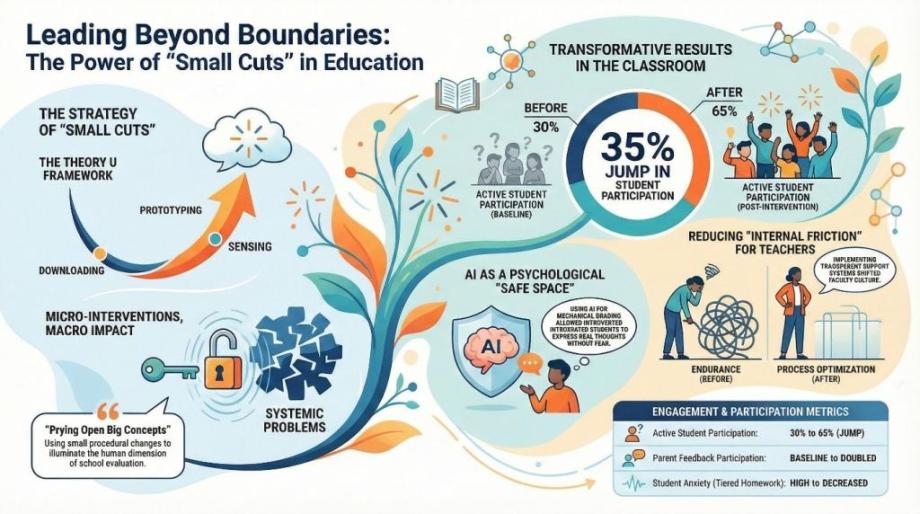
Leaders described how small, targeted interventions—introduced with clarity and discipline—produced effects that extended well beyond their original scope. These were not additional tasks, but precise changes to routines, processes, or feedback loops that altered how people experienced their work.
Three evidence patterns stood out.

Participation followed choice, not pressure
Engagement increased where students were offered structured choices within their learning. Autonomy, combined with visible indicators of progress, shifted students from passive compliance towards active participation. The insight was not that choice alone motivates learners, but that well-designed choice signals trust and agency.
Wellbeing improved when work became predictable
Teacher wellbeing emerged as a structural issue rather than an emotional one. Stress often stemmed from unpredictability—unclear expectations, invisible demands, and frequent interruptions. Small changes such as protected planning time or transparent request systems reduced internal friction, making work more manageable and focused.
Technology helped when it changed the emotional climate
Digital tools, including AI-supported assessment, proved effective when they reshaped emotional dynamics rather than simply increasing efficiency. When technology acted as a “first reader”, teachers were able to focus on interpretation and dialogue. For some students, this created a psychologically safer space to express thinking. Participants began to describe this as recognising that technology has an emotional temperature.
A shift in leadership assumptions
As evidence was shared, many leaders reflected that the most significant change occurred in their own thinking. Resistance was reframed as a lack of clarity rather than motivation. Parents were seen as willing partners without accessible tools. Teachers were understood to need protected cognitive space, not exhortation.
Leadership, in this framing, became less about directing behaviour and more about designing conditions that enable people to act well.
Why reflection mattered
The final session placed deliberate emphasis on collective reflection. Through structured group dialogue, participants articulated what had changed and why. This sense-making proved critical: action alone does not build leadership capability. It is through naming experience that insight becomes durable and transferable.
Leadership as ecosystem design
By the end of the session, a shared conclusion had emerged. Leadership is not primarily about fixing people or introducing ever more initiatives. It is about designing ecosystems—structures, routines, feedback loops, and protected spaces—that allow students, teachers, and parents to participate meaningfully.
The small changes examined during the review were not ends in themselves. They served as lenses, revealing how attention to conditions can unlock agency and support sustainable movement within complex systems.
For leaders beyond education, the reflection may resonate. In any organisation, the question remains the same: what small, thoughtfully designed change might reveal something fundamental about how your system really works?
Disclaimer
This article reflects independent reflections drawn from an action research process supported by Excellence First Enterprise Consultancy. The views expressed are those of the authors and participants and do not represent the official positions of other institutions.
Top image: Visualising how modest, carefully designed interventions can shape conditions for learning, participation, and professional wellbeing.