
The programme featured short presentations followed by a panel discussion with James Fry (Mills & Reeve), Lily Lin (Excellence First Enterprise Consultancy, EFEC), Professor Keith Jackson, and reflections from Paul Bowman (Barclays).
While China remains a significant global life sciences market, a consistent theme throughout the evening was that success depends on more than market size. Speakers emphasised the importance of approaching partnerships with realism, preparation and long-term responsibility, rather than relying on speed or assumption.
For UK organisations exploring international partnerships, the session highlighted the importance of decision clarity, trust-building, and governance discipline early in the process.
Beyond Culture: Systemic Differences in Partnership Logic
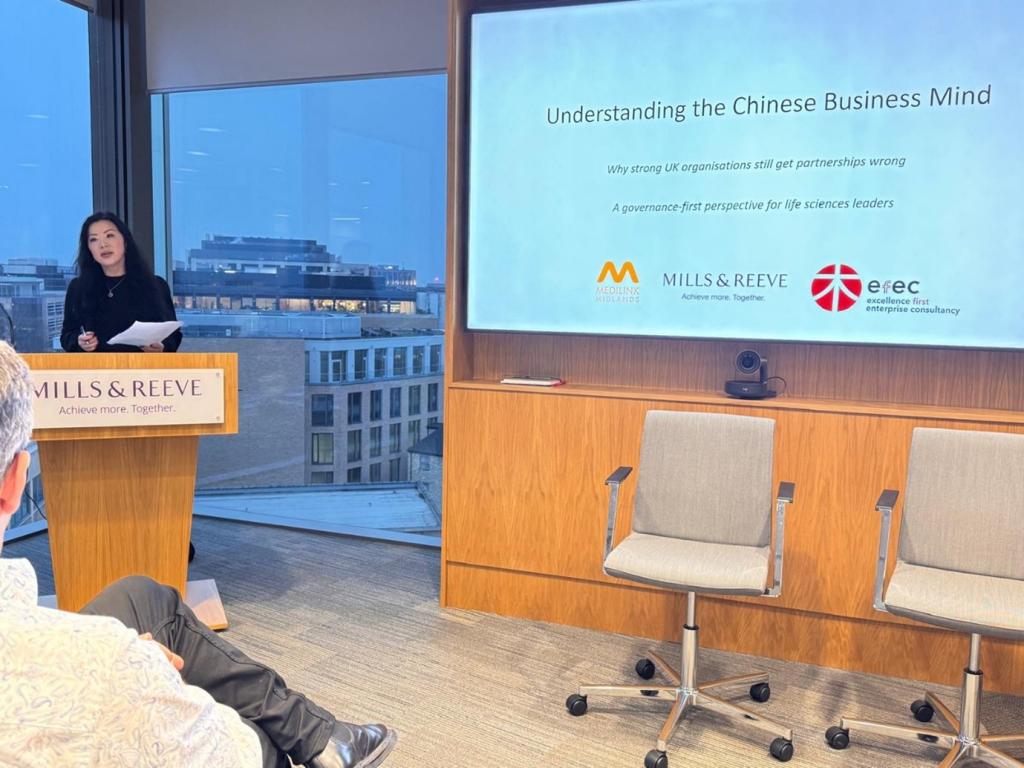
In her remarks, Lily Lin noted that discussions about doing business with China are often framed in cultural terms, but that many challenges arise from deeper, systemic differences in how partnerships are tested and decisions are made.
Drawing on EFEC’s cross-border experience, she highlighted three recurring patterns that frequently shape early-stage collaboration:
- Decision ownership — understanding who ultimately carries responsibility for a partnership decision
- Trust over time — recognising that trust is often built through observation before commitment
- Purpose of partnership — ensuring alignment on values, risk appetite and decision logic, not only technical capability
These differences matter because they often determine whether business discussions progress or stall long before any formal agreement is signed.
Legal and Structural Foundations
James Fry outlined several legal and structural areas organisations typically need to consider, including:
- transaction design (inbound and outbound licensing structures)
- IP strategy and enforceable confidentiality provisions
- data governance and clinical information transfer requirements
- due diligence and regulatory planning
- dispute resolution mechanisms and governing law choices
The discussion reinforced that governance should not be treated as an obstacle, but as part of what enables sustainable collaboration.

Execution Realities and Market Complexity
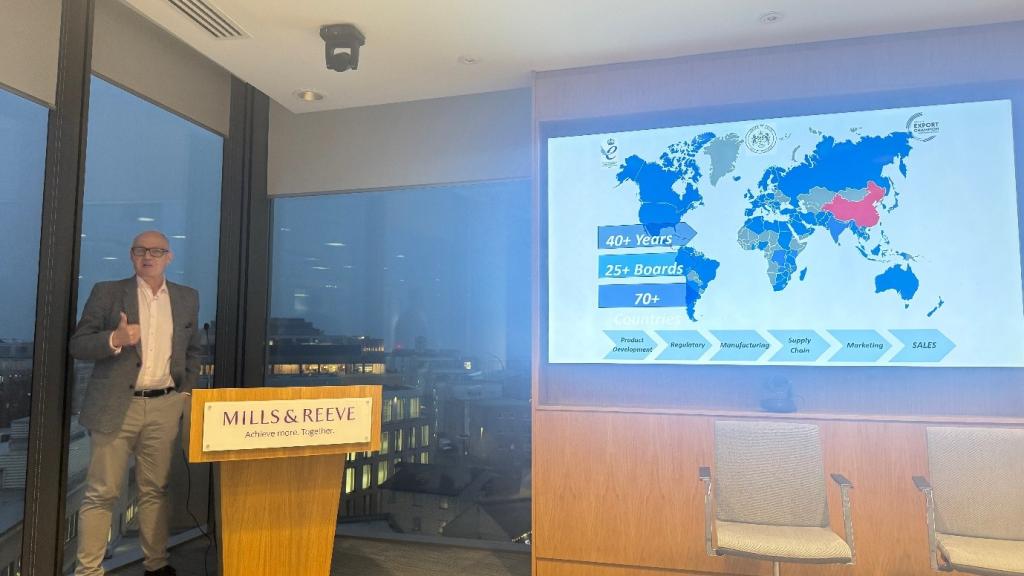
Professor Keith Jackson reflected on the long-term evolution of China’s medtech landscape and the operational realities of market entry. He emphasised that China is not a single uniform market, and that organisations often underestimate the localisation, execution discipline and in-market presence required to succeed.
Financing Perspectives and Risk Discipline
Paul Bowman offered a financing and risk perspective, noting the importance of disciplined preparation, clear decision ownership, and realistic expectations when organisations consider international expansion or partnership activity involving China.
His contribution reinforced the broader theme of the evening: that successful engagement is rarely about moving fastest, but about building structures that support responsible execution over time.
Designing for Uncertainty
Audience questions focused on how organisations manage uncertainty in cross-border partnerships:
- How early is too early to pause?
- How do you distinguish interest from commitment?
- Where do organisations most often misread trust?
Panellists suggested that resilient partnerships do not rely on perfect forecasts, but instead build governance structures that allow organisations to adapt safely, pause when needed, and scale only once alignment is demonstrated.
Three Practical Takeaways (as shared by Lily Lin)
In closing, Lily Lin concluded with three practical principles that UK medtech and life sciences organisations often find helpful when navigating early-stage China engagement:
- Pause earlier — not later. Test alignment before scaling commitments
- Treat governance as enabling infrastructure. Accountability and escalation matter as much as commercial terms
- Distinguish interest from alignment. Responsible progress is demonstrated over time
The evening closed with networking and continued discussion among attendees, underlining the value of experience-led ecosystem learning in navigating complex international partnerships.
Disclaimer:
This article reflects EFEC’s independent notes and interpretation of the session and does not represent the official position of Medilink Midlands, Mills & Reeve, Barclays, the speakers, or any other organisation. It does not constitute legal or financial advice.
Top image: Panellists following Medilink Midlands’ “Doing Business with China” session at Mills & Reeve, Cambridge (5 February 2026), from left to right: Paul Bowman, Lily Lin, James Fry and Professor Keith Jackson.