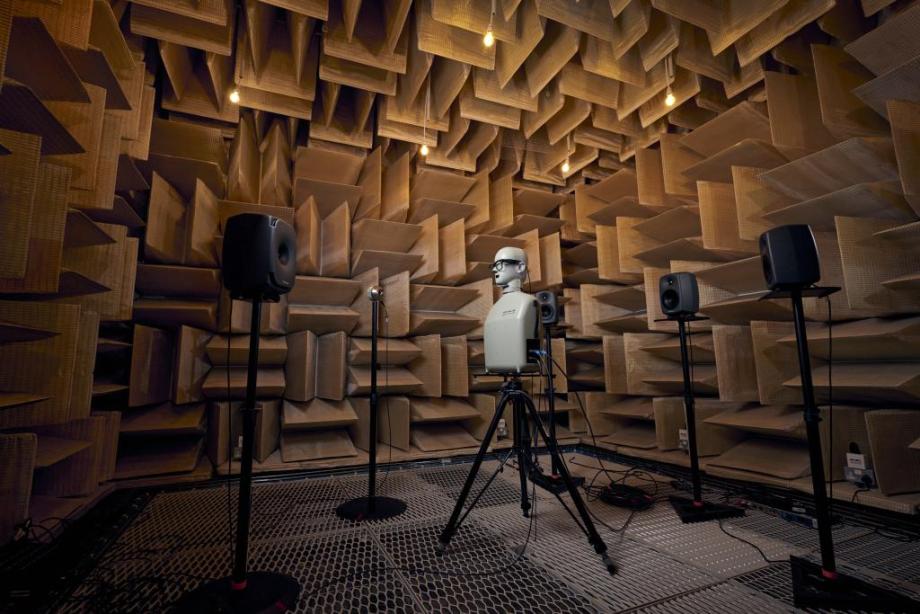
Today (09 July 2025), Meta has opened a new 16 million dollar (£12m) audio research lab in Cambridge, which is in the UK government’s Ox-Cam corridor. The facility will research and support audio developments for Meta’s future AR glasses and AI glasses, including Ray-Ban Meta and the recently announced Oakley Meta.
Built to replicate everyday acoustic environments with extreme precision, the state-of-the-art lab features:
- Ultra-quiet acoustic testing spaces: Anechoic and semi-anechoic chambers, including one large enough to house a family-sized car
- One of the world’s largest configurable reverberation rooms: 101 individually adjustable acoustic panels can simulate environments, ranging from a phone box to a cathedral
- Realistic, instrumented home environments: Kitchens, living rooms and other spaces fitted with sensors to test wearable devices under everyday conditions
- Motion tracking zones: 3,600 sq ft of space for AI to learn how users move and interact in real time using optical tracking with sub-millimetre accuracy
Designing sound that adapts to people and their surroundings
Meta is building the next computing platform designed to help people feel more present and connected. A key part of that vision is intelligent audio that adapts to people and their surroundings.
At the new audio lab in Cambridge, researchers are developing new ways for wearable devices to make sound smarter and more useful.
Audio that adapts in real time to users and their environment has the potential to transform everyday experiences, from chatting effortlessly with friends on noisy public transport, to walking through a busy city street and still being able to hear your podcast, even as traffic, chatter and construction happens around you.
Using advanced machine learning, teams are training glasses to detect where users are looking or turning their heads, and then enhance the sounds they want to focus on while reducing background noise.
“Creating this world class audio lab in Cambridge is a sign of our long-term commitment to the UK and our belief in the top engineering talent it produces. We want the brightest minds to make sure our smart glasses have the smartest AI-powered audio so you can focus on what you’re listening to no matter what’s going on around you. I can’t wait to experience the results of the work the lab produces.” – Joel Kaplan, Chief Global Affairs Officer - Meta

Pictured: Audio engineer Dimi conducts a sound test using a high-precision Genelec speaker inside the Cambridge lab’s anechoic ‘Sabine’ chamber.
Deepening Meta’s commitment to UK innovation
Situated in the heart of the UK’s Ox-Cam corridor, the facility strengthens the UK’s position as a global hub for technological innovation - joining a growing ecosystem of research centres, start-ups and global tech firms that are accelerating advances in AI. As Meta’s largest engineering base outside the US, the UK is home to over 5,500 employees. The audio lab strengthens Meta’s long-term presence in the region and supports the UK’s ambition to lead the world in the development of next-generation AI and immersive computing.
“Meta’s investment is a huge vote of confidence in the UK as a hub for world-leading research and innovation while helping to supercharge the potential in the Oxford to Cambridge growth corridor.
We want our high-tech industries to continue to lead the world in years to come which is why we’re backing our innovators, researchers and entrepreneurs with a record £22bn R&D funding, creating the opportunity for good jobs and investment in Britain, and delivering on our Plan for Change” - Chancellor of the Exchequer Rachel Reeves
With the investment of 16 million dollars (£12m), the Cambridge audio facility represents Meta’s long-term commitment to innovation in the UK, and to advancing how sound can enhance AI experiences and the future of computing by making them more natural, immersive and inclusive.