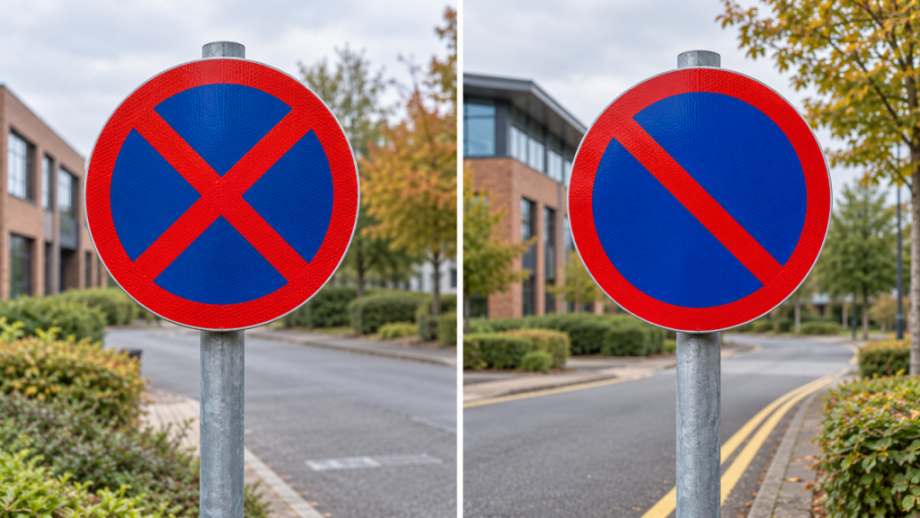
A no stopping sign has a red cross on a blue circle. A no waiting sign has one diagonal red bar. Both have a red border, but they give different instructions.
For anyone visiting a business, collecting an order or making a delivery, recognising that difference can prevent an awkward last-minute decision. This guide explains the signs used in Great Britain and how to read them alongside road markings.
What does a no stopping sign mean?
The circular blue sign with a red border and red cross means no stopping where the restriction applies. It is also commonly called a clearway sign. Check any additional wording for operating times or exceptions.
A no stopping restriction normally prevents even a quick passenger pick-up or drop-off. It concerns choosing to stop; drivers must still respond safely when traffic conditions require them to stop.
For a planned collection or delivery, identify a suitable parking or loading area before arriving.
What does a no waiting sign mean?
The single diagonal red bar means waiting is restricted. It does not automatically prohibit every brief stop: passengers may be picked up or set down, and goods may be loaded or unloaded where no separate restriction prevents it.
For example, stopping while a passenger gets into the car is different from arriving early and waiting for them. A designated collection area makes the arrangement clearer for both the driver and the person being collected.
Passenger boarding and goods loading are also different activities. A delivery driver needs to check the loading rules, rather than assume that a short visit is permitted.
What does a clearway sign mean?
On a 24-hour clearway, stopping is prohibited on the main carriageway, including slip roads and acceleration or deceleration areas. Special road markings are not required. A lay-by may be used unless signs prohibit it.
An urban clearway operates during the hours shown on its sign. During those hours, a brief stop to pick up or set down passengers is allowed. This exception is why drivers should read the complete sign rather than assume every clearway has identical conditions.
Yellow lines and kerb marks: two different restrictions
Yellow lines beside the kerb control waiting. Short yellow marks across the kerb indicate loading restrictions. Looking at both helps drivers understand what is allowed.
A single yellow line restricts waiting at particular times. Check a nearby time plate or the entry signs to the controlled parking zone.
Double yellow lines normally mean no waiting at any time, even without an upright sign. Signed seasonal restrictions are an exception.
A single yellow kerb mark indicates that loading is prohibited during the signed times. Double yellow kerb marks mean no loading at any time.
For businesses receiving deliveries, providing drivers with clear arrival instructions and a designated unloading location can reduce uncertainty at the roadside.
For marking parking bays and access routes on their own premises, businesses can source thermoplastic line marking from online suppliers, whose range often includes white and yellow line rolls, directional arrows and parking symbols.
Does “waiting restrictions apply” mean I cannot stop at all?
It refers to a waiting restriction, whose conditions must be checked on the signs. It does not automatically mean the same thing as no stopping. Passenger activity and permitted loading may be treated differently.
Read the symbol, operating hours and any zone information together.
Can I stop on double yellow lines?
Double yellow lines normally prohibit waiting, rather than every possible stop. Passenger pick-ups and set-downs, and loading where permitted, are treated differently. Check signs and kerb marks before deciding what is allowed.
Other rules still matter: never leave a vehicle where it causes danger or unnecessary obstruction.
Can I park after a single yellow line’s restricted hours?
The waiting restriction may have ended, but other parking rules still apply. Check the location, including entrances, crossings and junctions. An inactive yellow-line restriction is not a guarantee that every nearby space is suitable.
Helping visitors understand business premises
For a business, the useful test is whether a first-time visitor can find the right place to park, collect goods or make a delivery. Walk the route from the entrance and check whether signs, arrows, bays and pedestrian routes communicate a consistent layout.
The Health and Safety Executive’s workplace transport guidance recommends replacing faded markings when they are no longer effective. Suitable signs, lighting and separation of pedestrians from vehicles also contribute to a safer layout.
A practical review can identify faded bay boundaries, unclear directional arrows or collection areas that visitors struggle to find. Agree the intended layout with the site owner or manager before arranging marking work.