Alzheimer’s is the most common type of dementia, affecting around 600,000 people in the UK. CPFT is running specialist clinical trials to try and find NHS treatments that can slow or stop the underlying disease, working with participants across Cambridgeshire and Peterborough, and the East of England.
CPFT is supporting a major national trial to find better treatments for people with Alzheimer’s disease, called AD-SMART (Alzheimer’s disease Systematic Multi-arm Adaptive Randomised Trial). This trial is the first of its kind to test multiple drugs simultaneously, starting with two repurposed medicines already used to treat type 2 diabetes and attention deficit hyperactivity disorder (ADHD). Groups of participants will each begin treatment with a different drug. The study will examine whether these medicines can lesson symptoms like memory and thinking problems and help people maintain their quality of life as the disease progresses.
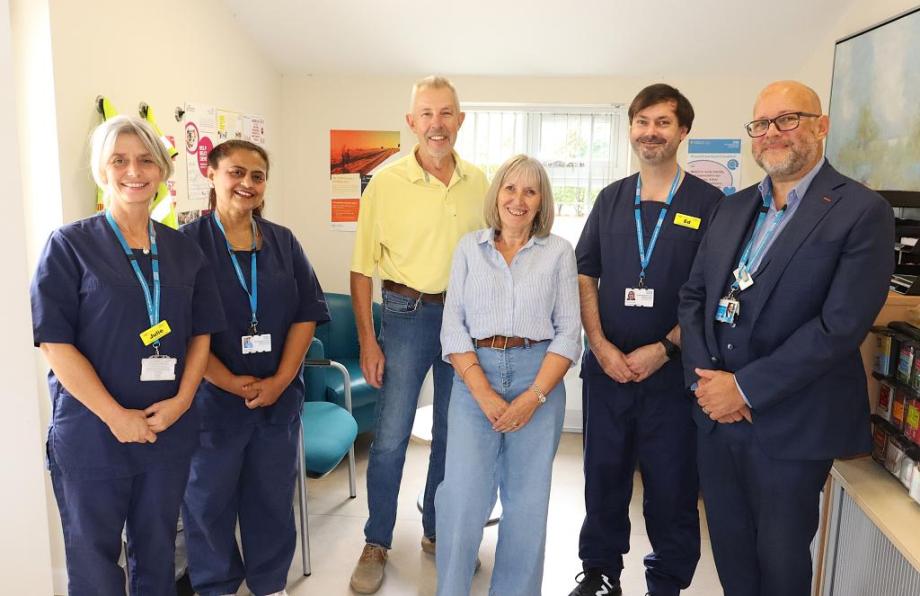
Cambridgeshire residents Angela and Steve Bucksey chose to take part in AD-SMART with CPFT and our dementia research experts close to their home. They said:
“Following Angela’s diagnosis, we decided to take part in a study at a local friendly research unit without having to travel into London, and it feels good to be doing something about it. By taking part we hope to be among the first to hear about the latest developments and access treatments that could help Angela and maintain the best quality of life. We would encourage anyone to join as it’s so easy and the team are great people to work with, you can talk to them openly and they understand everything about the disease and how to support us – you are in good hands!”
CPFT’s Research and Development Director and local principal investigator for AD-SMART Dr Ben Underwood said:
“We are delighted to welcome Angela and Steve to join the trial with us at CPFT and hope this research will directly benefit them and countless others living with Alzheimer’s disease. Our research would not be possible without people like them coming forward to help us. We will support them throughout their research journey and hope that many others will join to help test promising dementia treatments and ensure the most successful ones can be brought to NHS clinics as soon as possible. This type of trial could rapidly improve treatment for people living with dementia and our specialist team have worked hard to set it up at CPFT.”
AD-SMART is a type of trial known as a multi-arm, multi-stage platform trial. Several drugs are tested at the same time, and the results compared with one group of participants taking a dummy drug (placebo). This means more people receive an active treatment than would in a traditional trial.
Results are checked at regular stages throughout the trial and any drug that isn’t showing benefit can be dropped quickly, with new drugs added in its place. Overall, this means fewer participants end up receiving ineffective drugs. Testing several drugs against one shared placebo group means that ̶̶̶compared with a traditional trial, the time to evaluate treatments can be more than halved, which also reduces costs.
Testing drugs that are already approved to treat other conditions and known to be safe means that if proven to be successful, these treatments can reach people living with Alzheimer’s much faster than a medicine developed from scratch. As well as repurposed drugs, the trial is designed to test new potential treatments coming through the research pipeline.
AD-SMART is led by the UK Dementia Research Institute (UK DRI) and Alzheimer’s Research UK (ARUK) – in partnership with the National Institute for Health and Care Research (NIHR), the Medical Research Council (MRC) and Health Data Research UK (HDR UK), with ongoing funding committed by UK government to support the trial.
National Chief Investigator, Professor Paresh Malhotra, Group Leader at the UK Dementia Research Institute (UK DRI) Centre for Care Research and Technology at Imperial College London, said: “For too long, Alzheimer’s research has moved at the pace of one drug, one trial, one answer, sometimes taking a decade or more before we know if we’ve found something that works. We are applying advances from cancer and other conditions to accelerate testing of treatments for people with Alzheimer's disease. The way AD-SMART is set up means we’re testing several treatments at the same time, and those that don’t show promise can be quickly stopped. Then we can start testing something else. That’s the best way to get effective treatments to patients as quickly as we can.”
As well as CPFT, up to 20 NHS sites are expected to open across the UK over the next 12-18 months and more than 30 are planned overall. Researchers aim to recruit 1,200 participants across the UK to test these first two drugs. They expect to finish evaluating the first drugs in 2030, in around four years’ time. During this initial four-year period, the team expect additional drugs to be added into the trial for testing.
The two starting drugs were carefully chosen by an international panel of experts, together with people with lived experience of Alzheimer’s, based on evidence from earlier stage studies in patients as well as laboratory research. People with lived experience, working with a team at CPFT and the University of Cambridge, have shaped the trial from design, deciding which drugs to test and how success is measured. The POrtal for Patient and Public Engagement in Dementia research (POPPED) developed with Dr Ben Underwood helps people shape future dementia studies.
People with a confirmed Alzheimer’s diagnosis who would like to take part can contact the CPFT Research team at [email protected] or call 01223 219753.
To register for this study and find other opportunities to participate in groundbreaking trials to find new treatments for dementia, visit Join Dementia Research.