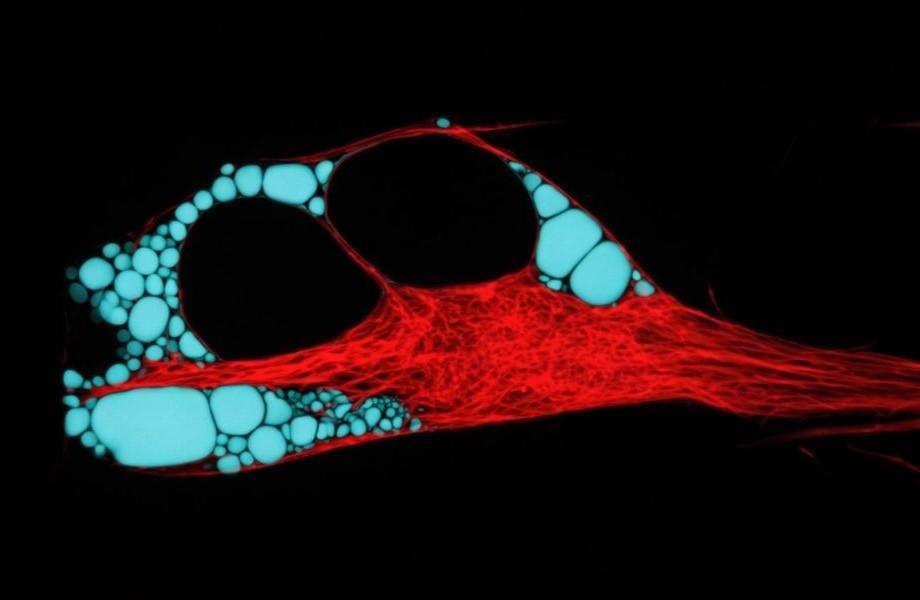
New research led by Prof Edward Avezov (UK DRI at Cambridge) reveals how the architecture of the cell’s transport network, the endoplasmic reticulum, can go awry and lead to problems with signalling in brain cells in conditions like Alzheimer’s. The study, published in Advanced Science, could lead to new therapeutic approaches for neurodegenerative conditions.
- Read the paper on Advanced Science: “Endoplasmic Reticulum Geometry Dictates Neuronal Bursting via Calcium Store Refill Rates and Exposes Selective Neuronal Vulnerability”
- The research team at the UK DRI Cambridge was led by Prof Edward Avezov and included Dr Valentina Davi and Dr Tasuku Konno.
What was the challenge?
The endoplasmic reticulum is a cellular compartment which acts as a major manufacturing and transport network inside the cell. In a neuron, it is the only organelle which spans the entire cell - you can imagine it as a folded network of pipes, like a tiny plumbing system of incredibly small 30–80 nm-wide tubules.
The shape of this network is tightly controlled by specialised proteins, which when dysfunctional are linked to a range of neurodegenerative conditions from hereditary spastic paraplegia to Alzheimer’s and amyotrophic lateral sclerosis. In this study, scientists aimed to understand why brain cells are particularly vulnerable to changes in the shape of the endoplasmic reticulum.
What did the team do and what did they find?
Using neurons made in the lab from human stem cells, the team investigated how the endoplasmic reticulum handles calcium – an essential chemical needed for neurons to ‘fire’ electrical signals to each other. They found that the endoplasmic reticulum – which acts as a storage tank for calcium – is the source of calcium fuelling neuronal firing. To fire repeatedly, a cell needs to quickly top up its calcium supply after each burst. The calcium gets moved around and restocked from calcium pools outside the cell, via the pipes of the endoplasmic reticulum.
The researchers discovered that when the shape of the pipes becomes disrupted, such as in disease, calcium can no longer flow efficiently to where it’s needed. This means the cell can’t restock fast enough to keep firing.
What is the impact?
This work highlights a potential therapeutic avenue: restoring normal function in the endoplasmic reticulum, to preserve brain function in ageing and slow or prevent neurodegeneration.
Prof Avezov explained:
“Our study shifts the attention in dementia research from the usual focus on individual components of the cell, to the physical design and how it makes the cell functionally fragile. We discovered that it’s about the shape of the cell’s plumbing system – which when disrupted, prevents cells from recharging fast enough and stops them from firing signals. Harnessing this may present a new therapeutic approach.”
The original version of this article was published by the UK DRI.