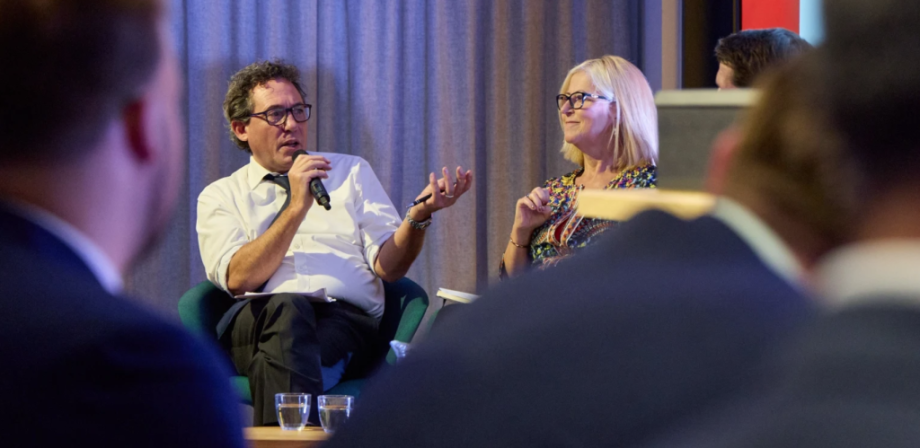
That was the focus of From Seed to Scale: Funding the ideas that change the world, a recent Cambridge Science Park event looking at one of the biggest challenges facing the UK’s science and technology sector: what happens after a promising company has proved its potential and needs to grow?
Moderated by BBC Business Editor Simon Jack, the panel brought together Charlotte Lawrence, Managing Director of Direct Equity at the British Business Bank; Jane Galvin, tech investor and adviser and former Managing Director of Corporate Banking at Barclays, HSBC and Santander; Will Hodson, entrepreneur and Chief Operating Officer of Looking for Growth; and James Hayward, Chief Operating Officer of Cambridge Future Tech.
Funding was inevitably a big part of the conversation, particularly the availability of capital as companies move beyond the early stages. But it quickly became clear that money is only part of the picture.
The discussion moved into the people needed to build and lead growing companies, the ability to turn brilliant science into something customers will buy, the difficulties young businesses face navigating procurement and regulation, and whether our attitude to risk is holding some of our most promising companies back.
Running through it all was a bigger question: what needs to change if we want more of the companies that start here to scale here too?
Keeping growing companies in the UK
The UK has developed a strong early-stage investment ecosystem. The picture can become more difficult as businesses grow and need much larger sums of capital.
Jane Galvin described one of the challenges as “finding the right growth capital at the right time at pace”. But it isn’t simply a question of how much money is available. Finding it can be difficult too. “Businesses really struggle with where to go”, she said.
Drawing on her experience working with growing businesses, Jane described a “sliding door moment” when a company meets the right person who can provide investment, bring others around the table and help unlock its next stage of growth.
The problem is that those connections can still depend heavily on who you know. Businesses know they need investment and investors know the kinds of companies they want to back, but the two do not always find each other.
Will Hodson argued that another problem emerges as businesses move beyond the early stages, when the pool of UK capital becomes thinner.
That’s often when overseas investors become increasingly important and, in some cases, the centre of gravity of a business can start to move with them.
But this wasn’t an argument against international investment.
Charlotte Lawrence was clear that overseas capital is an important part of the funding landscape. The issue is having enough UK capital able to invest alongside it as companies grow.
“What you want is a balance of capital”.
And, she argued, the desire to build businesses here already exists.
“People in the UK would rather stay in the UK and would rather build their businesses in the UK”.
The challenge is making sure they can.
Where a company scales matters. When businesses move, we risk losing more than a registered address. High-value jobs, intellectual property, experienced leaders, future investment and ultimately some of the decision-making can move too.
Cambridge has plenty to shout about
If the panel highlighted some of the barriers facing UK businesses, there was also plenty of optimism about what we already have.
Cambridge’s concentration of science, technology, talent and investment came up repeatedly.
James Hayward argued that we should be much louder about it:
“We need to really celebrate what we have. We need to tell the whole world about it”.
Jane echoed that sentiment. Recalling her first experience of Cambridge, she described it as “the best kept secret”.
“This is the best kept secret: the ecosystem we have here, the support, the infrastructure for these businesses”.
Her point was that the story of Cambridge is too often dominated by the difficulties businesses face, while the sheer number of companies already succeeding here gets less attention.
Cambridge has world-class research alongside science and technology companies at every stage of their development, experienced entrepreneurs, investors and a deep pool of talent.
The question is whether we do enough to tell that story.
Tackling the barriers to growth matters. But so does being much better at explaining what is already working here and why Cambridge remains such a strong place to start, build and grow a business.
Great science is only the start
Cambridge is very good at producing brilliant science and technology. But a great idea, however good, doesn’t automatically become a great company.
Charlotte argued that science and technology cannot do all the heavy lifting. If the ambition is to build a significant business, the technology needs to be matched by the ability to sell it and a commercial opportunity strong enough to justify the time, investment and risk involved.
For deep tech, that matters. It can take years to move from a scientific breakthrough to something ready for the market. The opportunity at the other end must be big enough to make that journey worthwhile.
James gave a striking example of what can happen when great technology doesn’t have a business around it.
His team came across an AI-enabled medical device developed at Bell Labs in Cambridge after seven or eight years of research. It could monitor vital signs through the ear, had a working app and a substantial patent portfolio. The technology was there, but it was effectively dormant inside a research lab.
“This is sitting here in a research lab in Cambridge doing nothing”, James recalled.
His reaction was simple: “Right, that is something. Let’s go and make that. Let’s go take a risk on it”.
That is the role Cambridge Future Tech has set out to play: finding promising technologies and putting the people, structure and investment around them to turn them into businesses.
Which leads to the question of who builds those businesses.
James was candid about the amount of advice already available to founders:
“You can find advisors coming out of your ears”.
What can be much harder to find are people prepared to get properly involved.
“You need somebody to muck in and come build it with you, to take a risk”.
That means finding experienced people prepared to come in early, build the team and commercial side of the company, and take some of the risk themselves.
James said that, somewhat unexpectedly, talent has become Cambridge Future Tech’s biggest area of investment when building companies at the earliest stage.
Cambridge doesn’t have an ideas problem. The harder job is building everything that needs to sit around those ideas if they are going to become major companies.
Are we too risk averse?
Risk was a thread running through much of the discussion.
Will summed up one of the challenges:
“Risk aversion in people, risk aversion in institutions, risk aversion around finance – all of this can be undone”.
And it isn’t just about whether an investor writes a cheque.
James talked about the difficulty of persuading experienced people to leave established careers and take a chance on a very early-stage company. Finding people with the right experience, ambition and appetite for risk can be as important as finding the capital to fund them.
Procurement came up too. A young company can have a great product, but selling into a large organisation or public body can take years. For a business with limited runway, that matters.
Then there is investment itself. Will questioned whether the UK’s traditionally cautious approach, including the way pension money is invested, means we are missing opportunities to back some of our most promising businesses.
He pointed to the scale of the money held in Cash ISAs as another example. Around £350 billion is sitting in them in the UK, he said. If that were a pension fund, it would rank among the ten largest in the world.
For Will, it was another illustration of our approach to risk: a vast pool of money sitting in cash rather than being put to work.
None of this means throwing caution out of the window. But if we want more UK companies to grow into global businesses, people and institutions must be prepared to take a chance on them.
The science can be ambitious. Perhaps the environment around it needs to be too.
From ideas to global businesses
There was no single answer to the UK’s scale-up challenge.
Capital matters, particularly when companies reach the point where they need serious growth funding. But the discussion made clear that money alone isn’t enough.
Businesses also need experienced people prepared to build them, customers willing to buy from them and a route through procurement and regulation that doesn’t exhaust their time and capital before they have a chance to grow.
And they need an environment in which ambition and calculated risk are encouraged rather than quietly squeezed out.
Cambridge already has many of the ingredients needed to build world-class companies. The opportunity is to strengthen the areas where gaps remain and be much louder about what is already here.
Because producing great ideas has never been the problem. The bigger test is turning more of them into great companies and giving those companies every reason to build their future here.
Highlights video: https://youtu.be/xYOfi_BbQTk?si=vtUmj221hMz-v_y1