
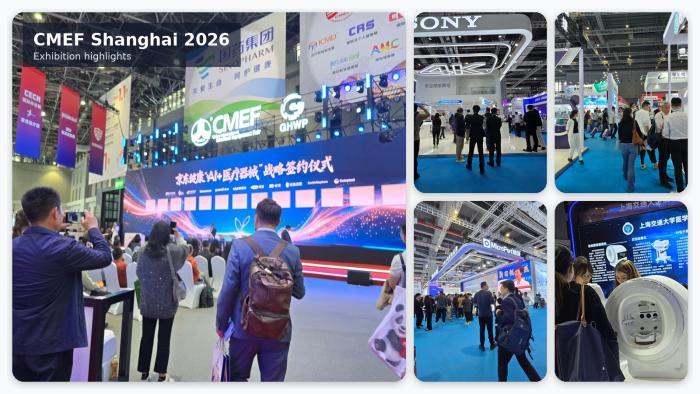
The 93rd China International Medical Equipment Fair (CMEF) wrapped up last week at the Shanghai National Exhibition and Convention Centre, running from 9 to 12 April 2026. By the headline numbers alone — over 320,000 square metres of floor space, nearly 5,000 exhibitors, and more than 300,000 professional visitors from 170+ countries — the event looked indistinguishable from its recent predecessors.
Four days on the floor told a different story. For anyone watching the China–UK medical device corridor, CMEF 93 was a fair of two halves.
One exhibition, two very different realities
A structural split ran through the show. On the cooling side were domestic-market-focused Chinese SMEs selling commoditised consumables and standard diagnostic equipment into tier-3 hospitals. Value-based procurement expansion, continued anti-corruption enforcement in hospital procurement, and tighter capex discipline in public hospitals were visibly suppressing on-site lead conversion. Several exhibitors on those stands quietly conceded that the show’s value to them is shifting from closing deals to maintaining brand presence.
On the warming side, three clusters of exhibitors described CMEF 93 as among their strongest in recent memory. Export-oriented Chinese manufacturers — particularly in in-vitro diagnostics, single-use consumables and home medical electronics — reported a notable uptick in buyer registrations from Southeast Asia, the Middle East, Latin America and the CIS. Platform-scale domestic leaders (United Imaging, Mindray, Deepwise, Haier Yingkang) used the show to unveil full-workflow ecosystems rather than individual devices. And a third group — suppliers of entry-level DR, 16-slice CT, POCT and portable imaging tailored for county-level hospitals — are riding a distinct policy tailwind: ultra-long-term special treasury bonds combined with China’s Thousand Counties Project are opening a structural equipment-refresh cycle in primary care.
The signal that matters most
The most revealing scene of the week was not on any main-hall stand but in Hall 6.1, where overseas clinicians and procurement leads queued to handle a 3.6 kg portable DR system built by a Chinese manufacturer (as reported by industry media Singularity Deep Vision / 奇点深视界). A decade ago, CMEF was where Chinese companies looked up to “GPS” — GE, Philips, Siemens. Today it is increasingly where international buyers, clinicians and regulators come to evaluate Chinese products.
For UK manufacturers, this has two immediate implications. First, the competitive landscape in third markets (EU, ASEAN, Gulf, Commonwealth) is shifting faster than official trade statistics suggest — Chinese exporters are no longer just low-cost challengers; many now present with CE, UKCA, FDA 510(k), ISO 13485 and GMP credentials as standard, positioning compliance itself as a core marketing asset. Second, the inbound opportunity for UK compliance expertise, regulatory consultancy and post-market surveillance services into the Chinese manufacturer base is growing, not shrinking.
A shift in regulatory centre of gravity
One of the quieter but more consequential themes of the week was the weight placed on regulatory alignment and market-access services. The third GHWP Global Medical Device Regulatory Harmonisation conference, co-located with CMEF, took AI medical device governance and global regulatory convergence as its headline tracks. Exhibitors marketing “end-to-end Southeast Asia market-access support” were cited by the organiser as a showcase of CMEF’s evolving role — from display-and-deal to compliance-and-export.
For UK readers, the overlap with the MHRA’s post-Brexit device regime, the EU MDR / IVDR transition, and FDA’s AI/ML device framework is direct. Chinese manufacturers are actively seeking technically literate partners who understand CE/UKCA route-to-market, UK Responsible Person arrangements, post-market surveillance obligations and post-market clinical follow-up. There is a meaningful services and partnership opportunity here for UK-based consultancies, authorised representatives, and specialist testing bodies.
Looking ahead
CMEF 94 will be held at Beijing’s Capital International Exhibition Centre from 21 to 24 October 2026, under the theme “Open China · Healthy World”, co-located with PHARMCHINA and the NHNE health-and-nutrition exhibition. For Cambridge Network members active in life sciences, medical devices, diagnostics, digital health and regulatory services, the Shanghai spring–Beijing autumn diptych remains the single most efficient annual snapshot of where Chinese MedTech is heading — and increasingly, of where it is prepared to meet UK counterparts as peers rather than suppliers.
This commentary is based on on-site observation at CMEF 93, direct conversations with exhibitors, and publicly available industry reporting.
NPZ Technology Ltd works at the intersection of China–UK medical device regulation, trade and market access.