
Leadership today is less about having the right answers and more about navigating complexity. Decisions are made with incomplete information, competing priorities, and constant pressure to move quickly. No leader sees the full picture alone. Every decision is shaped by personal experience, assumptions, and blind spots, often without us realising it. This isn’t a failure of leadership; it’s the reality of being human in an increasingly complex, cross-functional world where challenges compound and stakeholder demands continue to grow.
Modern leadership operates in environments defined by ambiguity and interdependence. The more complex an organisation becomes, the harder it is for any one leader to fully understand the implications of their decisions across teams, functions, and customers.
Research consistently shows that decision-making quality declines when leaders rely on homogenous viewpoints. Harvard Business Review has found that teams with greater cognitive diversity are significantly more effective at problem-solving and decision-making, particularly in uncertain or fast-changing environments.
Therefore, the challenge for leaders is not to go it alone, but to counterbalance blind spots by drawing on different perspectives, testing assumptions, and making choices that consider the wider impact.
Diversity as a practical response
This is where diversity becomes practical rather than ideological. Different perspectives don’t complicate leadership, they complete it. Diverse teams bring different lenses to the same challenge, reducing the risk of groupthink and improving the quality of judgement.
In practical terms, teams with diverse experiences make better decisions, identify risks sooner, and drive innovation more effectively. McKinsey’s 2023 Diversity Matters Even More report found that organisations with higher overall diversity are significantly more likely to outperform their peers, with top‑quartile diversity linked to stronger business outcomes and performance across functions (McKinsey, 2023).
But diversity alone doesn’t change outcomes. A diverse team is just a group of people where difference exists on paper and in metrics, but not in practice. Inclusion is the mechanism that turns diversity into impact. It determines whether perspectives are genuinely heard, whether challenge is welcomed, and whether contribution translates into influence.
Leading Inclusively: Turning Diversity into Impact
Creating a truly diverse and inclusive team requires more than representation, it needs leadership that actively models inclusion every day. Inclusive leaders ensure that different perspectives are not just present, but heard, valued, and acted upon. They make decisions about who participates in conversations, how voices can participate, whose ideas are explored, and who is given access to growth opportunities.
By leading inclusively, leaders turn diversity from tokenism into tangible outcomes: improved collaboration, stronger engagement, and a culture where everyone can contribute fully. Inclusion becomes a practical, measurable part of leadership, shaping not only team performance but also who is seen, recognised, and supported to rise.
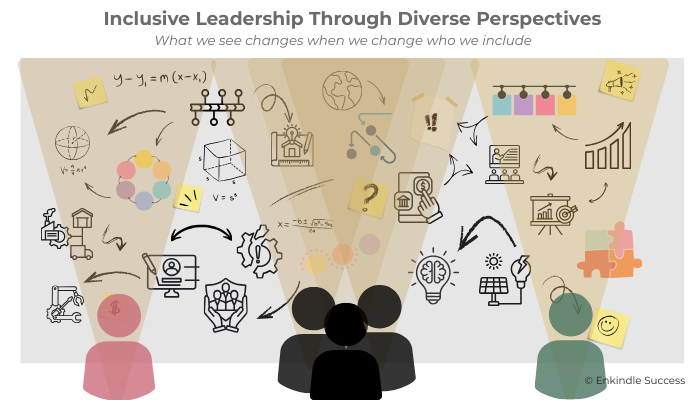
Why Inclusion Determines Who Rises and Who Lands Well
When inclusion is absent, organisations tend to reward a narrow set of leadership behaviours (often confidence, visibility, and alignment with historical norms), perpetuating the exclusion of diverse perspectives. Research from Catalyst highlights how leadership potential is frequently assessed through subjective markers rather than measurable impact, which limits who is recognised and promoted (Catalyst Insights, 2023).
Without inclusive leadership, talented individuals may rise on visibility alone but struggle to gain traction within their teams. Leaders can appear successful from a distance yet fail to build trust, engagement, or influence. Deloitte’s research on inclusive cultures shows that organisations with inclusive leadership practices are six times more likely to be innovative and agile, largely because feedback flows more freely and leadership impact is more accurately understood.
Inclusive leadership broadens how leadership is evaluated. It creates space for different working styles (e.g. analytical, collaborative, reflective, and people-centred) to be seen as credible and effective. Inclusion does not lower standards; it improves how talent and leadership capability are identified. By surfacing these dynamics early, organisations build stronger, more sustainable leadership pipelines, ensuring that leaders not only rise, but also land well.
Everyday inclusion: not just a DEI initiative
One reason diversity and inclusion can feel disconnected from leadership is that they are often framed as initiatives rather than behaviours. Policies and programmes matter, but they do not replace everyday leadership practice.
Inclusive leadership shows up in consistent, practical choices:
- Who is invited into decision-making conversations
- Whose ideas are explored rather than acknowledged
- Who is given access to development and stretch opportunities
- How disagreement and challenge are handled
These small, consistent choices shape culture. Over time, they influence engagement, retention, and performance in measurable ways.
Overcoming Outdated Fears and Misconceptions
Some leaders hesitate to fully embrace inclusion. Common fears include:
- “Including everyone will slow decision-making.”
- “It will dilute our culture.”
- “I’ll lose authority if I ask too many opinions.”
These fears are usually unfounded. Inclusive leadership doesn’t mean compromise, it means making better, more informed decisions. It doesn’t undermine authority; it strengthens credibility and trust. And it certainly doesn’t dilute culture, it deepens it, making it adaptable and resilient.
Inclusive and diverse leadership aren’t intimidating labels, but practical skills. Leaders who embed inclusion in their everyday behaviours often see their teams outperform, innovate, and stay engaged. Your people are the ultimate measure of your leadership: if they feel heard, respected, and empowered, the business benefits.
Making Inclusion Practical for Every Leader
Inclusive leadership works best when applied consistently in small, repeated actions. Here are practical steps to bring it into daily practice:
- Actively seek input from quieter voices – Rotate speaking opportunities, ask for feedback, and listen intentionally.
- Reflect on your blind spots – Regularly question whether your decisions are shaped by limited perspectives or assumptions.
- Rotate leadership in meetings or projects – Give different people a chance to lead or present; experience is as valuable as hierarchy.
- Encourage collaboration across teams and backgrounds – Include people who think differently to avoid echo chambers and stimulate new ideas.
- Recognise and reward inclusive behaviours – Celebrate leaders who bring others along, not just those who shine individually.
The key is consistency. Inclusive leadership isn’t about grand gestures; it’s about repeated, everyday choices that shape how your people experience you. Over time, these choices compound, strengthening engagement, performance, and the visibility of diverse talent.
Conclusion: inclusion is an everyday leadership habit
Rethinking diversity and inclusion as everyday leadership skills changes how we approach them entirely. They stop being initiatives to implement or frameworks to roll out and start becoming practical tools that shape how we lead in real time.
Inclusive leadership is visible in ordinary moments: who is invited into the conversation, how decisions are made under pressure, and whether people feel confident bringing their full perspective to the table.
When leaders move beyond initiatives and focus on real-world application, diversity and inclusion become less intimidating and far more effective. They support stronger decision-making, deeper engagement, and teams that are able to adapt and perform in complex environments.
Ultimately, this isn’t about labels or compliance. It’s about leadership measured not by perception or position, but by the experience of the people you lead.