Cambridge is home to some of the world’s strongest early-stage biomedical and MedTech research, but turning breakthrough science into clinical-ready devices remains one of the region’s biggest translation challenges.
As the University of Cambridge has recently launched its new Institute for Biomedical Innovation (IBI), Professor George Malliaras has drawn attention to a persistent UK bottleneck: the difficult step from a promising lab prototype to a regulated medical device ready for clinical trials, developed with patients and regulatory requirements in mind. “There’s a real gap in the UK between a clever prototype that works in a lab and something that’s suitable for clinical trials,” he said.
Fragmented path to developing medical devices
This reflects a broader issue facing many Cambridge spin-outs and early-stage MedTech companies. While the region brings together world-class science, clinical insight and entrepreneurial drive, the path to developing devices suitable for verification and clinical testing remains fragmented. As a result, many teams look overseas for regulated manufacturing support - not due to a lack of innovation, but because early-stage UK infrastructure often requires them to piece together supply chains, tooling and regulatory expertise themselves. This fragmented approach can be slower, riskier and more costly than more integrated options available abroad.
Scaling manufacturing demands synchronising process development, tooling, supply chains, skills, funding and regulatory readiness. Professor Tim Minshall, Head of the University of Cambridge’s Institute for Manufacturing, has highlighted the complexity of bringing new science into production.. “If the UK is to remain internationally competitive, we must strengthen our ability to capture value from the scaling up of new ideas emerging from our amazingly strong science base. To do that requires an integrated approach to innovation and manufacturing,” he said.
Lack of opportunities to test approaches
The real bottleneck is not proving that a device can work once, but learning how to manufacture it reliably, safely and at a quality level suitable for regulatory and clinical evaluation.
IBI co-Director Professor Ronan Daly agrees: “It’s about learning how to make (technologies) reliably, safely and at a quality level that is traceable and regulators will accept. That’s where so many good ideas fail - not because the science is wrong, but because there is no opportunity to test out the manufacturing challenges early enough.”
Without opportunities to develop and test manufacturing processes early, at realistic batch sizes, many promising ideas struggle to progress beyond the lab.
Keeping MedTech innovation and manufacturing in the UK
While this challenge is visible in Cambridge, it reflects a wider national issue. As the UK sharpens its focus on industrial strategy, there is growing concern about its ability to retain and scale high-value MedTech innovation domestically. Recent findings from the House of Lords(2) highlight the risk of promising technologies moving overseas when the scale-up pathway is fragmented.
Reports from organisations including the Centre for Process Innovation (CPI) reinforce this point(3), identifying a national gap in early-stage, regulation-aware manufacturing support - one that disproportionately affects SMEs. Without access to responsive, integrated capability, many companies are forced to look abroad earlier than planned, taking expertise, jobs and future production with them.
Strengthening this part of the ecosystem will be critical if breakthroughs developed in Cambridge are not only discovered here, but scaled and manufactured in the UK.
Supporting clinical translation without leaving Cambridge
TTP, based in the Cambridge area, has been helping medical device teams navigate this critical transition for decades. Through its integrated medical device manufacturing capability, TTP supports companies as they move from design into clinical and early production builds, developing the manufacturing process in parallel and preparing for smooth transfer to full-scale manufacturing when the time is right.
Rather than operating as a traditional high-volume contract development and manufacturing organisation (CDMO), TTP focuses on bridging the gap between early-stage innovation and regulated production, offering:
- Rapid, controlled builds to support verification and clinical timelines
- Flexible manufacturing with no minimum order volumes, from one-offs through to early series production
- ISO 13485-certified processes where required, with full traceability and documentation
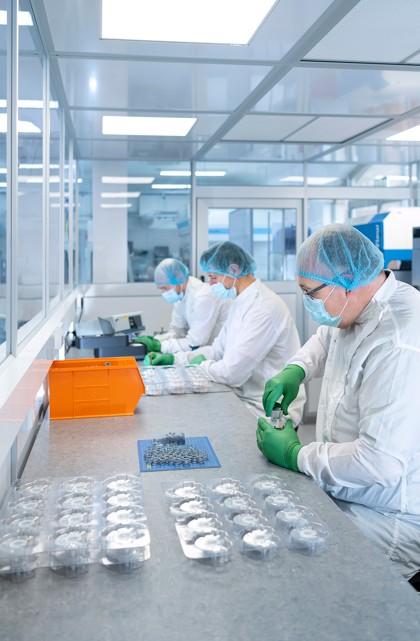
- Cleanroom facilities, complex system assembly, and specialist microfabrication under one roof
- Manufacturing engineering expertise to de-risk design transfer and scale-up.
By keeping design, manufacturing, and iteration tightly connected, TTP helps innovators avoid late-stage surprises, maintain momentum, and reach the clinic sooner, while building the evidence and process maturity needed for long-term success.
For Cambridge-based MedTech companies looking to move beyond the lab and into clinical reality, TTP’s manufacturing and development teams offer a local, integrated pathway to get there.
To learn more about how TTP supports clinical-stage device development and manufacturing scale-up, visit Medical Device Prototyping and Manufacturing - Clinical Builds and Scale-Up or contact the team directly.
Sources:
1New Cambridge institute will support high-value medical device translation – University of Cambridge Engineering
2 Bleeding to death: the science and technology growth emergency – the House of Lords Science and Technology Committee Report
3 CPI Challenges and Opportunities for UK HealthTech Manufacturing Scale-up Report