The Scale and Speed of AI Adoption
China’s healthcare system, the world’s largest by patient volume, faces immense challenges: an ageing population, uneven distribution of medical resources, and surging demand for high-quality care. In response, over 300 top-tier hospitals have rapidly deployed advanced AI platforms such as DeepSeek, integrating them into patient services, diagnostics, research, administration, and hospital management. According to industry projections, by the end of 2025, up to 90% of Chinese hospitals will use some form of AI-powered technology.
AI Agents: Beyond Chatbots to Autonomous Healthcare
The real breakthrough in 2025 is the rise of AI Agents. Unlike traditional AI models that mainly provide question-and-answer support, AI Agents can reason, remember patient histories, plan workflows, and interact with complex hospital systems. They are being developed for both general and highly specialised medical fields, handling tasks from generating detailed patient records to interpreting medical images and supporting complex clinical decisions.
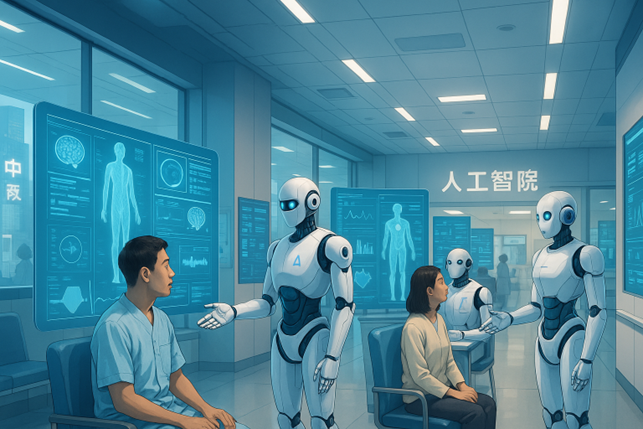
A landmark moment came with the launch of the world’s first “Agent Hospital” by Tsinghua University. Staffed by 42 AI doctors, this virtual hospital can independently manage the entire patient journey—from triage and diagnosis to treatment and follow-up. In simulated trials, these AI doctors demonstrated diagnostic accuracy on par with human experts, highlighting the disruptive potential of such technology.
Specialisation and Workflow Transformation
Chinese hospitals are prioritising the creation of specialist AI Agents for areas such as urology, infection control, and liver cancer. These Agents are trained on structured, high-quality clinical data and knowledge graphs curated by medical experts, enabling them to handle highly complex and specialty-specific tasks. This approach is helping to address disparities in healthcare access and enhance the quality of care in underserved regions.
Beyond clinical care, AI Agents are streamlining hospital operations—automating administrative approvals, managing staff schedules, and optimising resource allocation. Hospitals such as Zhongshan and Renji have already launched multiple AI-powered platforms to improve efficiency and patient experience.
Policy, Regulation, and Investment
China’s government is actively steering this transformation. National strategies such as the Healthy China 2030 Initiative and the National AI Strategy prioritise AI in healthcare, with significant funding from both central and provincial governments. New regulatory frameworks are being introduced to ensure safety, data privacy, and ethical standards, including guidelines for clinical use and insurance reimbursement of AI-assisted services.
The healthcare AI market is projected to grow at an annual rate of over 23% from 2025 to 2033, driven by demographic pressures, innovation, and strong policy support. Both government and venture capital are heavily investing in this sector.
Challenges and Lessons for the UK
Despite rapid progress, challenges remain. Most hospital data in China is unstructured and not easily used for AI training, and integration across diverse IT systems is complex. Regulatory frameworks are evolving to keep pace with these changes, and there are ongoing debates about responsibility and oversight when AI-driven decisions affect patient outcomes.
For the UK, China’s experience offers several lessons:
- Scale and Speed: China’s ability to rapidly pilot, scale, and iterate on new technologies—often with strong government backing—offers a model for large healthcare systems.
- Specialisation: The focus on specialist AI Agents and workflow automation is addressing both workforce shortages and the need for more equitable healthcare.
- Regulatory Innovation: China’s evolving approach to regulating medical AI provides a valuable reference for UK policymakers.
- Collaboration Opportunities: With Shanghai and Beijing leading in AI healthcare innovation, and with UK-China partnerships already active in education and business, there are significant opportunities for joint research and co-development of AI-driven healthcare solutions.
Looking Ahead
China is moving rapidly from AI “experiments” to deep, scenario-driven applications that are transforming its healthcare system. The rise of AI Agents marks a new era, with the potential to reshape not just Chinese healthcare, but also to inspire and inform global innovation—including within the NHS.
Excellence First Enterprise Consultancy Ltd stands ready to facilitate knowledge exchange and collaborative opportunities between UK and Chinese partners as this revolution unfolds.
Key Sources:
- “AI医疗战火升级!Agent爆发,大三甲争相引入,医疗系统新一轮变革!” 智药局, 2025.
- “世界首个Agent医院来了!42位AI医生独立坐诊,诊断准确率超越人类医生” 动脉网, 2025.
- “China’s Healthcare AI Market Report 2025–2033,” EqualOcean, 2025.
- “Healthy China 2030: China’s National Strategy for Health,” Chinese State Council, 2024.
- “Artificial Intelligence in Healthcare: China’s Regulatory and Market Landscape,” McKinsey & Company, 2025.
For further discussion or partnership enquiries, please contact Excellence First Enterprise Consultancy Ltd.