By Lily Lin, CEO, Excellence First Enterprise Consultancy.
“What has AI ever done for us?”
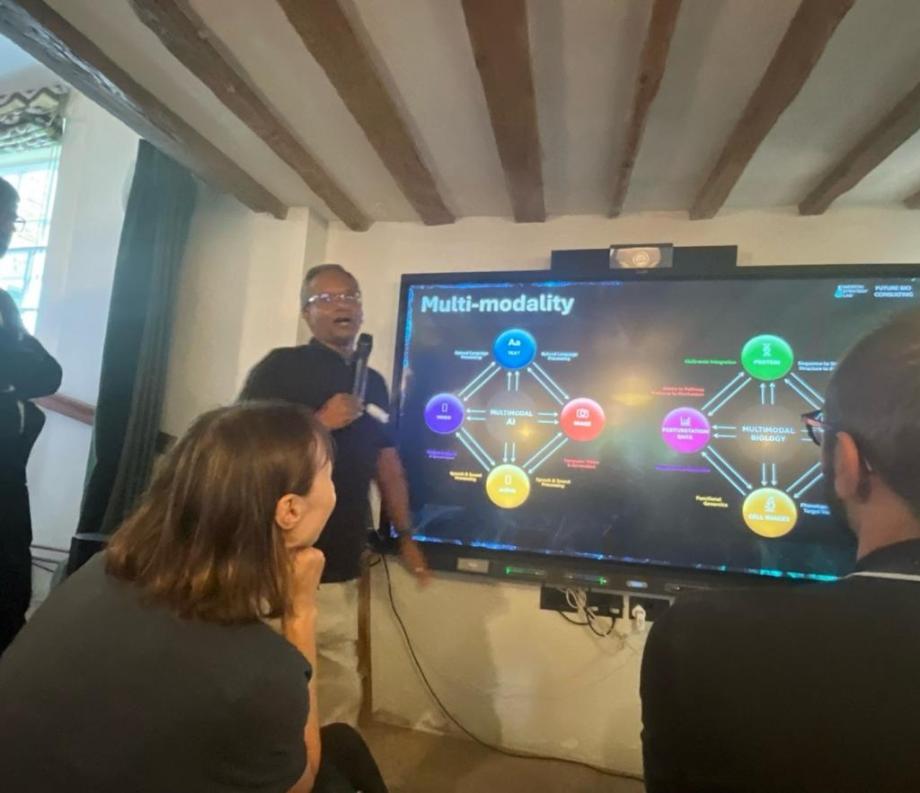
Hitesh Sanganee borrowed the question from Monty Python when he opened his contribution to the Cambridge TechBio Caucus working lunch at Hauxton House.
Co-hosted by Hitesh Sanganee and Prashant Shah, the session brought together people from biotech, pharma, investment, research and the wider Cambridge ecosystem. Much of the discussion was not about what AI might eventually do. It was about what people are already doing with it.
Hitesh began with examples that were surprisingly ordinary.
He talked about using AI to create presentations and animations, building small applications without being a coder, and connecting different sources of information to create tools for his own use. He described “micro apps”: people increasingly building something for themselves for a very specific purpose, sometimes with an audience of one.
The discussion then moved into more scientific territory: competitive analysis, protein structures, generative chemistry and multimodal biology.
I will leave the technical detail to those better qualified to explain it. AI was no longer being discussed only as a tool that produces text about scientific work. Another term that came up was “orchestration”: different models, data sources and workflows drawn together around a single task. In some settings, AI was becoming part of the scientific workflow itself.
The questions from the room began to test what this meant in practice.
One participant with a clinical background raised the issue of responsibility when AI becomes part of clinical decision-making. If an AI-supported decision goes wrong, where does accountability sit?
Another contribution raised a different issue. Tools that once required specialist technical expertise are becoming much more accessible. That is useful, but it also raises another question: whose expertise is needed to use them properly?
Then came a simpler question:
How do you know what is missing?
An AI system may process an extraordinary amount of information, but a polished result does not necessarily tell us what it failed to find, or what was absent from the data in the first place.
At one point, Hitesh used the word “verifier” to describe part of the human role around AI. The term raised the possibility that experienced people may increasingly be asked to challenge and interpret work produced with AI.
It was near the end of the session when I asked about younger people entering the sector.
With so much capability becoming accessible so quickly, what should we be doing differently to give them enough exposure to understand what AI can do, while still developing the knowledge and judgement needed to make good decisions?
There was no neat answer. Different approaches are already being tried. Some institutions are placing limits around AI use while students develop fundamental knowledge. At the same time, preventing young people from learning how to work with AI brings its own risk.
For much of the lunch we had been looking at technology doing things that would have seemed remarkable not very long ago. Those examples also left a question about the people who will enter this sector next.
If experienced professionals increasingly become the people who verify what AI produces, how does someone at the beginning of their career develop the judgement to become one of them?
Editorial note: This article reflects observations arising from EFEC’s participation in the Cambridge TechBio Caucus working lunch during Cambridge Tech Week. It does not attempt to report the session in full or represent the views of the organisers or participants.
Image: Cambridge TechBio Caucus working lunch during Cambridge Tech Week. Photo: EFEC