
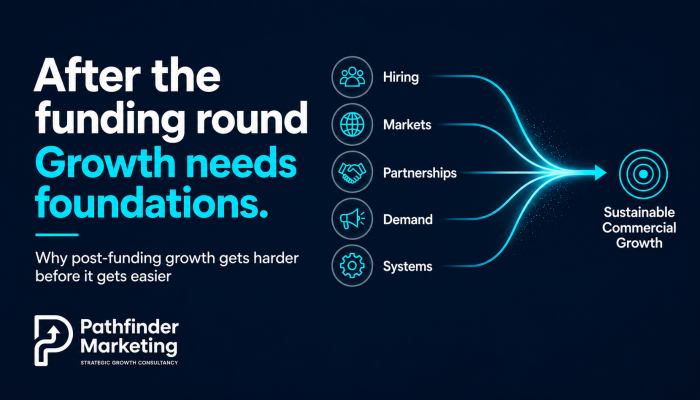
Securing investment is a significant milestone for any business.
For an early-stage life sciences company, it may mean moving from scientific validation towards commercialisation. For a technology business, it might create the opportunity to accelerate customer acquisition or enter new markets. And for a more established company, new investment can provide the capital needed to reposition, expand or build the next phase of growth.
But funding does not create growth by itself.
In many businesses, raising capital or committing to a more ambitious growth target actually exposes weaknesses that were less visible before: an unclear proposition, uncertain priorities, disconnected sales and marketing activity, limited commercial data, or a growth plan that relies more on individual effort than on a repeatable system.
The challenge is therefore not simply deciding how to spend the money.
It is deciding what needs to be built around the investment to give it the best chance of producing a commercial return.
The gap between ambition and commercial readiness
Before a funding round, businesses are often understandably focused on achieving the milestone immediately in front of them.
That might mean completing product development, reaching a scientific or technical milestone, demonstrating product-market fit, winning early customers or building an investment case.
After funding, the questions change.
Who are our priority customers?
What problem are we solving for them?
Why should they choose us?
Which markets or segments should we focus on first?
How will we create demand?
What should sales and marketing be responsible for?
What does a commercially viable customer acquisition model look like?
And how will we know whether the strategy is actually working?
These can sound like straightforward questions. In practice, many growing businesses have only partially answered them.
That creates several common challenges.
1. Too many growth priorities
Fresh investment creates possibilities.
New markets. New hires. New campaigns. New partnerships. New products. Events. Paid media. PR. Sales development.
The danger is trying to pursue too many of them at once.
For a growing business, focus is often more valuable than activity.
A useful starting point is to translate the overall commercial objective into a small number of priorities. If the objective is to generate £2 million of incremental revenue, for example, which customer segments are most likely to contribute to that target? What needs to happen over the next 12 months? And which activities are genuinely critical to achieving it?
A clear growth strategy should help the business decide what not to do as much as what to do.
2. A proposition that has not evolved with the business
Early customers often buy for very different reasons from later-stage customers.
Founders may win the first handful of clients through personal relationships, technical credibility, industry networks or their own ability to explain the opportunity.
That becomes harder as the business scales.
The organisation needs a proposition that can be understood and communicated consistently by other people.
For technology and life sciences businesses in particular, there is an additional challenge: companies understandably describe themselves through the sophistication of their technology, science or intellectual property.
Customers, however, usually make decisions based on outcomes.
A strong proposition connects the two. It explains what is distinctive about the business, but also why that distinction matters commercially to the customer, partner or stakeholder.
3. Moving from founder-led growth to a repeatable system
In many early-stage companies, growth initially depends heavily on the founders.
They generate introductions, attend events, pitch the business, manage partnerships and often oversee marketing alongside numerous other responsibilities.
That can work extremely well during the early stages.
It is rarely scalable.
The next stage requires a growth system that can operate beyond the personal networks and individual efforts of the leadership team.
That does not necessarily mean building a large marketing department.
It means establishing some basic commercial infrastructure: a clearly defined audience, an agreed proposition, a route to market, a method for generating and developing opportunities, effective sales processes, appropriate technology and meaningful performance measures.
Complexity can come later.
4. Sales and marketing developing independently
Another common problem is the separation of sales and marketing.
Marketing generates activity. Sales pursues opportunities. Both teams report their own performance.
But nobody is necessarily looking at the complete commercial journey.
That can result in familiar symptoms: plenty of leads but too few genuine opportunities, disagreement about lead quality, inconsistent follow-up, limited visibility of the pipeline and difficulty understanding which activities actually contribute to revenue.
The solution is not simply better marketing or better sales.
It is a connected commercial model.
Marketing activity should be designed around the type and volume of opportunities the business needs. Sales capacity should reflect the volume of demand being generated. And both functions should work from common definitions, priorities and commercial objectives.
5. Spending before the economics are understood
Once funding is available, the temptation is understandably to start generating activity quickly.
Agencies are appointed. Campaigns begin. People are hired. Technology is purchased.
But spending more does not automatically accelerate growth.
Before increasing investment in lead generation, businesses should understand the economics behind it.
How many customers are required to achieve the revenue target?
How many qualified opportunities will be needed to generate those customers?
How many leads or target accounts need to enter the funnel?
What conversion rates are realistic?
What can the business afford to spend to acquire a customer?
Working backwards from the commercial outcome makes it much easier to determine what level of marketing investment is sensible and whether the growth plan is commercially viable.
6. Hiring before the growth model is clear
A funding round often triggers recruitment.
A Head of Marketing. Growth Lead. Sales Director. Business Development Manager. Marketing Manager.
These can all be entirely appropriate appointments.
But hiring someone into an undefined commercial system can create an unfair challenge for both the individual and the business.
Before recruiting, leadership teams should be able to articulate what the person is being hired to achieve, the commercial priorities they will support, the resources available to them and the measures by which success will be judged.
In some cases the right first step may be a permanent senior hire.
In others, the immediate requirement is to establish the strategy, infrastructure and operating model before building the internal team.
7. Measuring activity rather than commercial progress
Growing businesses rarely suffer from a shortage of data.
CRM systems, websites, advertising platforms, email tools and social channels can produce an enormous number of metrics.
The challenge is identifying which ones matter.
Traffic, impressions, clicks and enquiries may be useful indicators, but they do not necessarily tell the leadership team whether the growth strategy is working.
A useful commercial dashboard is usually much simpler.
Are we generating enough of the right opportunities?
Are those opportunities progressing?
Where are we losing them?
What is our conversion rate?
How long does the sales cycle take?
What does it cost to acquire a customer?
And which sources are contributing most effectively to revenue?
These measures allow investment decisions to be based on evidence rather than instinct.
Start with the commercial foundations
None of these challenges is unusual.
They are often a natural consequence of a business moving from one stage of growth to another.
The mistake is assuming that increased investment should automatically translate into increased marketing activity.
For many organisations, the better first step is to establish the commercial foundations.
That means being clear about:
- where growth will come from
- who the priority audiences are
- the proposition and positioning
- the route to market
- how demand will be generated
- how sales and marketing will work together
- the commercial economics behind customer acquisition
- the systems, data and measures needed to manage performance.
Once those foundations are in place, decisions about recruitment, agencies, campaigns and technology become much easier.
More importantly, the business can begin to move from individual initiatives towards a repeatable growth system.
Funding creates opportunity. Strategy determines how well it is used.
Investment can provide a business with the resources to move much faster.
But speed amplifies both good and bad decisions.
The businesses that make the most of new investment are therefore not necessarily those that launch the most campaigns, hire the largest teams or enter the greatest number of markets.
They are often the ones that create clarity first: clarity about the commercial objective, the customer, the proposition, the route to market and the growth system required to deliver it.
That may feel less exciting than immediately increasing activity.
But it gives every pound invested afterwards a much better chance of contributing to sustainable growth.