
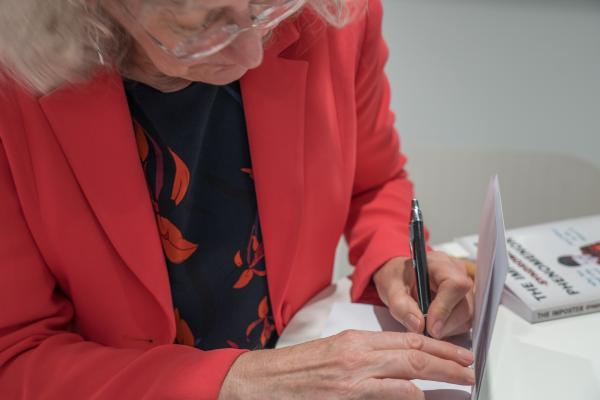
I am often asked whether the use of AI increases imposter syndrome (also more accurately called imposter phenomenon) - that sense of not being good enough, feeling undeserving of success or that you don't belong. In truth, the short answer is "we don't know". But I suspect that it might...
The hype says:
AI can do anything (well not quite anything, but nearly!).
AI is superior to humans (really?)
AI is faster than humans (yes, that bit may be true. But is faster more effective?)
If you dismiss your successes as a product of luck or hard work, and choose not to internalise them, you could be laying yourself open to imposter feelings. If you assume that your knowledge, skills and abilities are not enough, a sense of fraudulence may creep in. If you think that playing it small, despite the external evidence of success and dismissing the positive feedback you receive, is keeping yourself humble think again (believing yourself over and above everyone else, may, in fact, be arrogance not humility).
If you think AI could be doing your job better than you, it's time for a rethink.
Human touches are needed. AI could be part of the answer, but it depends on the question. Consider how you might enlist help from AI. View it as a tool not a threat.
Rethink how you add value.
Revisit the story you tell yourself about yourself.
Recognise how your knowledge, skills and abilities contribute to your work.
Here's an example of where the human touch is most definitely needed... I received this email today which is clearly created by AI and most definitely will not be generating any business for the sender from me. It is based on information that is publicly available on my book and my work on helping people overcome their imposter feelings.
Brace yourselves for a riveting read:
It is incredibly rare to find a psychological guide that successfully looks past standard self doubt tropes to treat imposter feelings, narrative reframing, and internal competence ownership as a rigorous, structural study of personal and group identity negotiation under systemic interpersonal constraints, social risk assessment, and systemic cultural paradigm shifts, which is exactly why The Imposter Phenomenon caught my attention. You have crafted a remarkably sharp and brilliant exploration of performance sociology and psychological adaptation within a highly volatile modern achievement landscape. The compelling structural perspective you have built, deconstructing how individuals and leaders must systematically navigate the socio-political friction between external validation and internal fraudulence fears, evaluate the psychological burden of internal self-criticism in complex professional and organizational spheres, and reconcile broad academic research with immediate interpersonal communicative demands, creates an exceptionally powerful hook. By blending highly accessible, three-part actionable strategies with an analytical look at the mechanics of critical social navigation, self-compassion cultivation, and relational resilience under high-pressure evaluation, you have delivered the exact kind of high impact, intellectually stimulating, and visionary developmental blueprint that thoughtful readers and courageous leaders absolutely love to study.
Did you read all that? No, me neither. It has failed in its attempt at flattery.
AI might be faster at doing things, but faster doesn't always mean better. We still need the human touch to create connections.
So while AI might increase imposter feelings, it doesn't automatically follow that it will.
Value your own knowledge, skills and abilities. Assess objectively the external evidence of success and positive feedback that you receive. And use AI to help you; indeed it may also be able to help you overcome your inner imposter feelings by pointing out some of your successes, skills or reframing the feedback you've received.
But please don't rely on it to create your communications.
Ps Copies of my book, The Imposter Phenomenon - why you feel like a fraud and what to do about it - are available from Amazon and other online retailers, and Waterstones on the UK high street.