
Most organisations would never put someone into a specialist technical role and simply hope they worked out how to do it.
Yet we do something remarkably similar with management.
Someone becomes excellent at what they do. They build credibility, solve problems and become the person others rely on. Then comes the natural next step:
“We'd like you to manage the team.”
Their job changes overnight.
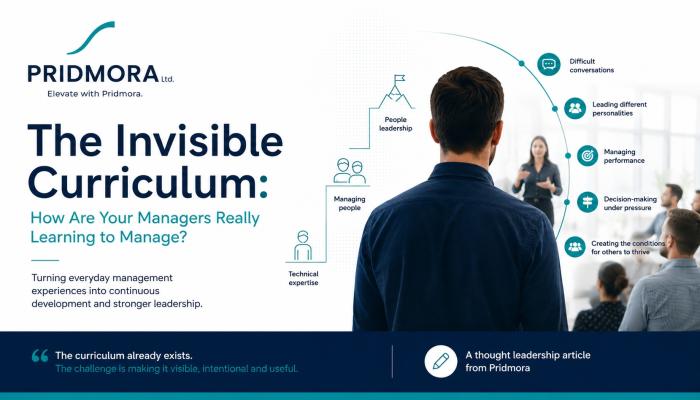
Success is no longer just about their own expertise. They need to give difficult feedback, delegate effectively, manage performance, handle conflict, motivate different personalities, make decisions under pressure and create the conditions in which other people can perform.
But where do they learn to do that?
Often, through what I think of as the invisible curriculum of management.
They watch other managers. They remember how previous managers treated them. They experiment. They make mistakes. They ask trusted colleagues. They search online. They attend a management course and then return to a workplace where the difficult conversation they actually need to have bears little resemblance to the case study they discussed.
Eventually, many become good managers.
But there is an important question for organisations:
How much are we leaving to chance along the way?
The gap isn't necessarily training
Management development is often framed as a learning problem:
What training should we provide our managers?
There is another question worth asking:
How do managers develop while they are actually managing?
Because much of management capability is built between formal development interventions.
It happens before the first difficult performance conversation.
After the team meeting that didn't go as planned.
When a technically brilliant employee suddenly needs something their manager doesn't know how to provide.
When a new manager realises that solving the problem themselves is no longer the same as leading others to solve it.
These moments are not interruptions to management development.
They are management development.
This matters particularly in growing organisations
The challenge can become especially visible in organisations built around specialist expertise.
Engineering, technology, science, healthcare and other knowledge-intensive businesses depend on people becoming exceptionally good at what they do.
As organisations grow, some of those people naturally begin leading projects, supervising colleagues and eventually managing teams.
Their technical credibility may be exactly why they were promoted.
But technical excellence and management capability are not the same thing.
That doesn't mean organisations should stop promoting specialists. Quite the opposite.
It means we need to become much more deliberate about what happens after they make the transition.
What if development followed the work?
Imagine a different model.
A manager faces an important conversation.
They prepare for it.
They consider what they want to achieve, what the other person might need and how they intend to approach it.
They have the conversation.
Then they reflect.
What worked? What didn't? What did they notice about themselves? What would they do differently next time?
Those experiences accumulate.
Patterns begin to emerge.
Confidence develops alongside evidence.
Instead of management development being something that happens occasionally, it becomes part of how management itself is practised.
Formal training and coaching still have an important role. But they sit within a much more continuous process of development.
There is an organisational opportunity too
If managers are developing through real work, organisations should be able to learn from that process without turning development into surveillance.
Over time, appropriate aggregated insight can help People and L&D leaders understand where managers are gaining confidence, where common development needs are emerging and where additional support may be valuable.
That changes the conversation from:
“Who completed the management programme?”
towards:
“How is management capability actually developing across our organisation?”
That is a much more interesting question.
Making the invisible visible
Perhaps the biggest opportunity in management development isn't another course.
It is recognising that an enormous amount of development is already happening every day: in conversations, decisions, mistakes, reflections, relationships and moments when someone discovers that managing people requires something very different from being excellent at their previous job.
The curriculum already exists.
The challenge is making it visible, intentional and useful.
I'd be interested to hear from Cambridge Network members: how does your organisation support people making the transition from specialist expertise into management?