This approach combines 3D-QSAR and Free Energy Perturbation (FEP) to efficiently identify the strongest-binding bioisosteric replacement with minimal computational cost.
Register here: https://cresset-group.com/about/events/active-learning-fep-using-3d-qsar/
Date
Date: Thursday 27th February 2025
Time: 2pm GMT / 3pm CET / 9am ET
Duration: 45 minutes
Format: Webinar
Abstract
Bioisostere replacement is a powerful and popular tool used to optimize the potency and selectivity of candidate molecules in drug discovery. Selecting the right bioisosteres to invest resources in for synthesis and subsequent optimization is key to an efficient drug discovery project. In this retrospective study, we used human aldose reductase inhibitors to demonstrate an active learning workflow that prioritizes molecules from a large pool of bioisostere replacements generated by Spark1. This workflow combines two rigorous computational approaches: 3D-quantitative structure activity relationships (3D-QSAR) with shape and electrostatic descriptors2, and free energy perturbation (FEP) for binding free energy calculations in Flare1. This workflow can rapidly locate the strongest-binding bioisosteric replacements with a relatively modest computational cost (a total of only 16% of the candidate pool was processed with FEP requiring 20% or even less GPU hours than if FEP were to include all candidates). The ROC-AUC for selection of known actives in 80 top-ranked candidates improved to 0.88 from 0.64, and the top picks were enriched with highly potent ALR2 inhibitors, including the well-known clinical candidate Zopolrestat developed by Pfizer3,4.
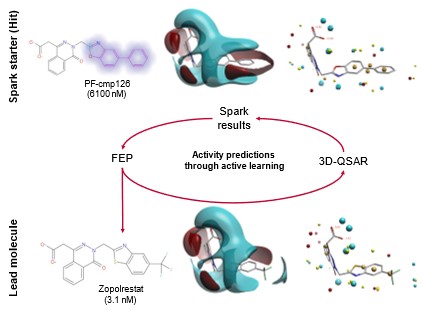
Figure 1: Graphical overview of the active learning workflow showing the starter molecule (PF-cmp126 with the region selected for R-group replacement highlighted) and one of the most potent lead molecules (Zopolrestat) identified by this workflow. 2D representation, 3D molecular electrostatic potential and field points of the molecules are shown (colour code: Red for positive, blue for negative, yellow for shape and orange for hydrophobic).
References
- Flare™, Cresset®, Litlington, Cambridgeshire, UK, https://www.cresset-group.com/software/flare/; SparkTM. https://www.cresset-group.com/software/spark/
- Cheeseright, T., et al., Molecular field extrema as descriptors of biological activity: definition and validation. J Chem Inf Model., 2006, 46, 2, 665-6 DOI: 10.1021/ci050357s.
- Mylari, B.L., et al., Novel, potent aldose reductase inhibitors: 3,4-dihydro-4-oxo-3-[[5-(trifluoromethyl)-2-benzothiazolyl] methyl]-1-phthalazineacetic acid (zopolrestat) and congeners. J Med Chem., 1991, 34, 1, 108-1 DOI: 10.1021/jm00105a018.
- Mylari, B.L., et al., Potent, orally active aldose reductase inhibitors related to zopolrestat: surrogates for benzothiazole side chain. J Med Chem., 1992, 35, 3, 457-4 DOI: 10.1021/jm00081a006.