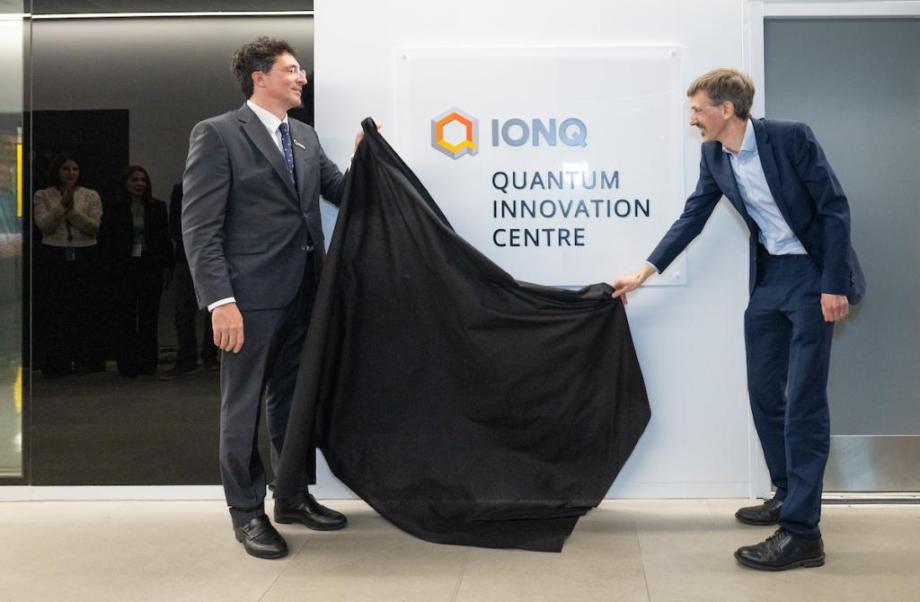
COLLEGE PARK, Md. IonQ, the world's leading full-stack quantum platform and foundry, and the University of Cambridge announces the opening of the first-ever university-based IonQ Quantum Innovation Centre. The Centre is located at the Ray Dolby Centre, the new home of the University's Cavendish Laboratory. This initiative brings the University's largest corporate research partnership from agreement to a physical home at one of the world's leading facilities for physics research.
The IonQ Quantum Innovation Centre demonstrates the company’s commitment to quantum innovation and academic research within the United Kingdom. Research at the Centre includes co-development of new quantum network nodes and sensing capabilities with the university, and a strengthening of the existing Cambridge-to-Bristol quantum network. IonQ and the University of Cambridge first announced the partnership on March 11, 2026, supporting advanced research and workforce development for quantum technologies.
“The opening of the IonQ Quantum Innovation Centre turns a landmark agreement into a working home for quantum research inside one of the world’s most storied physics laboratories,” said Niccolo de Masi, Chairman and CEO of IonQ. “By bringing quantum computing, networking, sensing, and security research together at Cambridge, we are accelerating the timeline between academic discovery and commercial quantum advantage. This is a long-term commitment to the United Kingdom, built for researchers, start-ups, and industry alike.”
The Centre’s nine inaugural research projects will bring together Cambridge researchers and IonQ specialists to advance quantum hardware and explore new applications across science and industry. Selected by a Joint Steering Committee comprising business and scientific leaders from both organizations, the projects combine Cambridge’s research expertise with IonQ’s capabilities in trapped-ion quantum computing, quantum networking, and device engineering.
Experimental projects address key capabilities for building larger quantum systems. One will develop microscopic mirrors designed to collect light from trapped ions more efficiently, laying the groundwork for optical connections between quantum processors.
Computational projects will investigate how quantum algorithms can solve difficult problems in chemistry, materials science, finance, engineering, and medicine. Highlighted research within this group will construct investment portfolios that maximize expected returns at a given level of risk, model how engineering structures respond to forces, and investigate biological networks to identify potential targets for cancer therapies.
The program draws on Cambridge’s Departments of Physics, Engineering, and Computer Science and Technology, the Milner Therapeutics Institute, and Cambridge Judge Business School. Across the projects, students and postdoctoral researchers will gain experience connecting fundamental research with technology development and applications, helping train the next generation of leaders in quantum science and engineering.
“The official launch of the IonQ Quantum Innovation Centre is an exciting milestone in our partnership with IonQ, which will help Cambridge and the UK stay at the forefront of the quantum revolution,” said Professor Mete Atatüre, Head of the Cavendish Laboratory. “The announcement of the first round of the funded research projects celebrates the depth and breadth of expertise and talent at Cambridge, and will accelerate our impact in quantum science and engineering.”
IonQ will deploy a Superion 256-qubit quantum computer and an entanglement-distribution quantum network at the University. This quantum technology will support related work involving quantum memory chips and frequency-conversion technologies, as well as provide access to IonQ quantum computers through the IonQ cloud. The on-campus IonQ quantum network will consist of two Quantum Networking Data Centres and three Quantum Networking Nodes. As part of the collaboration, Innovate UK, the UK’s innovation agency, will provide access and computing time for the National Quantum Computing Centre (NQCC) over three years.
"The Centre combines Cambridge's research strength with IonQ's networking, sensing, and security capabilities. It transforms into a facility where new quantum network nodes, sensing techniques, and the intellectual property behind them are developed side by side," said Jordan Shapiro, President, Quantum Platform at IonQ. “That work feeds directly into our platform roadmap, and it gives researchers, partners, and customers a stronger foundation to build on.”
The partnership supports new academic positions, postdoctoral fellows, and PhD students at Cambridge, and aligns with the UK National Quantum Strategy. The Centre also deepens IonQ’s presence in the United Kingdom.