Business leaders, senior government, military officials, and top research institutions from across the UK will gather at the University of Cambridge’s New Whittle Laboratory for the Frank Whittle Summit – a landmark event convened to transform and accelerate the UK's approach to innovation in hardware development and manufacturing across aerospace, energy and defence.
AI is dramatically accelerating hardware innovation across the aerospace, energy and defence sectors. Britain has the capacity and the audacity to compete and win in a global race.
Professor Rob Miller, Director of the New Whittle Laboratory
The event, on Monday (20 July), will kickstart a series of upcoming innovation missions to pioneer new technologies and industries in Britain, harnessing AI and autonomous laboratories to collapse today's multi-year development cycles from years to months. It will also seek to mobilise new capital to back UK projects and engineering talent, turning scientific advantage into industrial strength.
An initial proof-of-concept pilot mission, made possible by philanthropic gifts from Lord Sainsbury of Turville and Peter Bennett, with support from Rolls-Royce, has demonstrated these capabilities. This has resulted in the development of a novel cryogenic jet engine, representing the biggest shift in jet engine design since Frank Whittle's original design, and in nine new patents being filed by the project team. Rolls-Royce plans to use these learnings to accelerate technology development for its future narrowbody engine.
Around 20 to 30 such missions could be launched over the coming decade, potentially resulting in up to £30 billion in economic value to the UK and creating as many as 10,000 new skilled jobs.
The event also marks the official opening of the New Whittle Laboratory, a new £58 million facility at the University of Cambridge. This encompasses two elements: the Bennett Innovation Lab – a mission capability designed to launch 20-30 missions over a decade, each building a new industry in the UK; and the National Centre for Propulsion and Power – a rapid test capability designed to cut the time to test at real conditions from years to weeks.
Professor Rob Miller, Chair in Aerothermal Technology and Director of the Whittle Laboratory at the University of Cambridge, said: "AI is dramatically accelerating hardware innovation across the aerospace, energy and defence sectors. Britain has the capacity and the audacity to compete and win in a global race.
"What’s missing is a bold new approach that champions rapid iteration over incremental improvement. That’s why we’ve established the Bennett Innovation Lab – a sovereign mission capability designed to launch transformative new missions, each of which is designed to build or transform a UK industry."
University of Cambridge Vice-Chancellor, Professor Deborah Prentice, said: "We need to speed up innovation in the UK's engineering sector. The Bennett Innovation Lab offers the incredible opportunity for the UK to build a mission capability which can deliver UK-leading science into new industries at an unparalleled pace. This will be a partnership between Cambridge and the other leading technology clusters and institutes across the UK. It's only by building a partnership of the UK's leading clusters that we can deliver the speed of technology development and deployment that the UK needs."
The formal opening of the New Whittle Laboratory marks another significant milestone in the development of the Cambridge West Innovation District, home to the University’s world-leading research in science and technology.
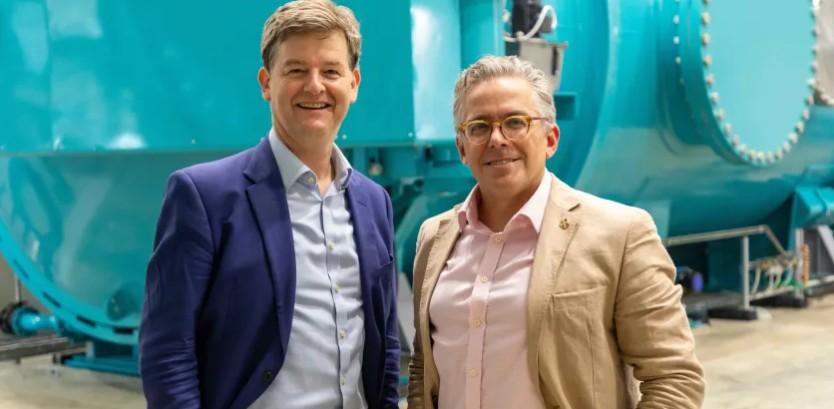
Image credit: Natalie Hall/SDC - Rob Miller, Director of the Whittle Laboratory, and Elliott Grant, co-head of the new Bennett Innovation Lab
Reproduced courtesy of the University of Cambridge.