Hundreds of sophisticated models have already been developed by researchers, but they are currently rarely used beyond the lab or institution where they were created. Despite these scientific advances, many promising models struggle to achieve adoption at scale because of challenges with reproducibility, validation and standardisation.
We are witnessing extraordinary advances in our ability to model human biology and disease. Yet many of these innovations never make it beyond the laboratories where they were developed. Our ambition is to change that.
Matt Zilbauer
The UK Pre-clinical Translational Models Hub has been established to help realise the full potential of these next-generation models by ensuring they are fit for purpose and made available to the wider scientific community.
The Hub is hosted at the Cambridge Stem Cell Institute at the University of Cambridge in partnership with the MRC Laboratory of Molecular Biology and the Wellcome Sanger Institute. Its location on the Cambridge Biomedical Campus places it within a vibrant ecosystem of healthcare, research and life sciences organisations, helping to accelerate the translation of science into patient benefit.
The models, known as New Approach Methodologies (NAMs) have the potential to transform how diseases are studied and treatments are developed. They include a range of approaches including miniature organs (‘organoids’) developed from patient tissue, advanced cell-based models and computational approaches powered by AI.
Many NAMs are created using tissue samples donated by patients during routine clinical procedures, enabling the development of models that retain important characteristics of human biology and disease.
NAMs could help researchers better understand diseases such as cancer, Alzheimer’s and inflammatory bowel disease and be used to better predict whether potential new treatments will be safe and effective in people.
Ultimately, these models could also support more personalised approaches to medicine by helping predict how individual patients may respond to specific treatments. Over time, these complementary approaches could also potentially reduce or replace animal models.
Professor Matthias Zilbauer, Director of the UK Pre-clinical Translational Models Hub, University of Cambridge, said: “We are witnessing extraordinary advances in our ability to model human biology and disease. Yet many of these innovations never make it beyond the laboratories where they were developed.
“Our ambition is to change that. By bringing together world-leading expertise from academia, healthcare and industry, we want to create a national engine that accelerates the development, validation and adoption of New Approach Methodologies.
“Ultimately, our vision is for the UK to lead the world not only in developing innovative human disease models, but in translating their potential into real-world clinical and societal impact, delivering better medicines and better outcomes for patients.”
Translating promising preclinical results into patient benefit remains a major challenge. More than 90% of drug candidates that enter human clinical trials fail to achieve regulatory approval, highlighting the need to adopt new models that better predict whether new treatments will work in patients.
The first-of-its-kind national Hub will work with partners across academia, the NHS and industry to validate a range of models and accelerate their use in clinical research and drug discovery across the UK. The Hub will also collaborate with regulators and policymakers to establish common standards for benchmarking and validation of new models.
Through this coordinated national effort, the hub will create a defined pathway for NAMs to progress towards real-world applications in biomedical research, drug development and patient care.
Since being awarded £20 million of core government funding earlier this year, the Hub has moved at pace to build its team and establish a national network of academic, clinical and industrial collaborators.
The Hub will be officially opened on Friday 27 November in the presence of invited guests from across industry, academia, healthcare, government and regulatory organisations.
Dr Richard Torbett, Chief Executive of the Association of the British Pharmaceutical Industry (ABPI), said: “Industry will be one of the main users of these models, so it is vital that industry, academia, and regulators work together on shared standards that everyone can trust. ABPI members are ready to play their part and want to see these methods adopted responsibly, with patient safety always the priority.
“By turning promising models into tools that are used with confidence across medicines development, the Hub can help patients benefit from better medicines and make the UK an even more attractive place to discover and develop them.”
Adapted from a press release from Cambridge University Health Partners
Reproduced courtesy of the University of Cambridge.
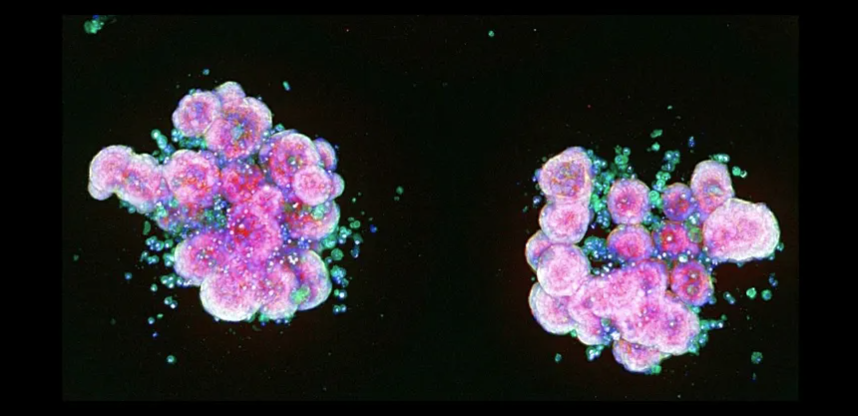
Image Credit: Human intestinal organoids Zilbauer lab