
Why a strong technology product doesn’t automatically create a repeatable route to market
Early customers can demonstrate a product’s potential. Building a consistent way to attract and win the next customers requires a different kind of work.
For a growing technology business, the first customers are an important milestone. Someone has recognised the problem, understood the proposition and committed money to the solution.
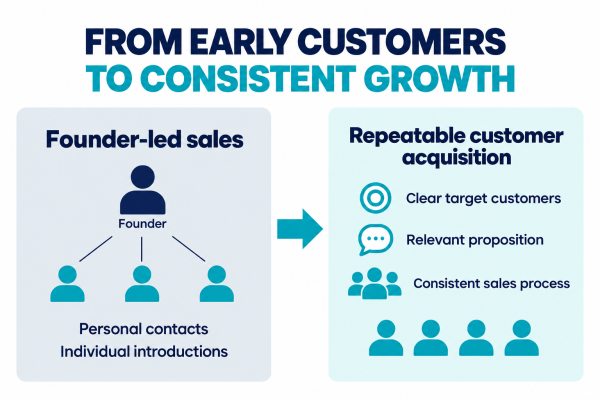
But those early wins don’t necessarily establish how the business will acquire customers consistently.
A founder’s network, an investor introduction or a particularly enthusiastic early adopter can open doors that a marketing campaign cannot easily reproduce. Those relationships may also conceal how much explanation, reassurance and personal involvement it took to secure the sale.
For technology and software businesses in Cambridge and beyond, the next commercial challenge is therefore not simply generating more awareness. It is understanding which parts of early success can be repeated—and building a practical route to market around them.
Early traction and repeatability are different things
Consider an illustrative software business that has won its first customers through the founder’s professional network.
Each customer values the product, but for slightly different reasons. One wants to save time. Another needs better reporting. A third is interested in a specialist feature.
The business now wants to accelerate growth. It appoints a marketing supplier, launches campaigns and invests in prospecting tools.
However, some important decisions remain unresolved. Which customer type should the campaigns target? Which problem should lead the messaging? Who owns the budget? What evidence will persuade someone who has never met the founder?
The product may be strong. The missing piece is a sufficiently clear customer-acquisition approach.
More activity can help test those questions. It cannot remove the need to answer them.
1. Choose a market you can pursue deliberately
A technology product may have applications across several sectors. That creates opportunity, but it can also make commercial focus difficult.
Different markets bring different buying processes, competitors, implementation requirements and expectations of value. Trying to address all of them at once can spread a small team’s resources too thinly.
A useful starting point is to examine existing customers and credible prospects:
- Where is the problem most urgent?
- Which organisations can recognise and fund a solution?
- Where is the product a strong fit without extensive customisation?
- Can the business reach similar buyers efficiently?
- Which customers offer an attractive balance of revenue, delivery effort and sales-cycle length?
The objective is not to abandon every other opportunity. It is to choose where to build a repeatable approach first.
2. Translate capability into a reason to act
Technical differentiation matters. But a prospective customer also needs to understand why that difference is commercially relevant.
An AI-enabled platform might process information faster or identify patterns that existing tools miss. Those capabilities become more persuasive when connected to a specific problem: reducing manual work, improving a consequential decision or helping a team respond sooner.
That connection needs to be credible. A broad promise to “transform performance” is less useful than a clear explanation of what changes, for whom and under which conditions.
There is also a distinction between a problem worth solving and a purchase worth making now.
A buyer may recognise the value but still prioritise another project. Effective positioning therefore needs to address the cost or consequence of continuing with the current approach—not just the advantages of the new technology.
3. Understand the decision beyond the first interested user
The person who likes a product is not always the person who can approve its purchase.
A technical evaluator may focus on performance and integration. An operational leader may be concerned about adoption and disruption. A commercial or financial decision-maker may need a clearer case for investment.
These are not simply different versions of the same sales message. They are different questions that the buying organisation needs answered.
Marketing and sales should work together to identify:
- Who experiences the problem.
- Who evaluates the solution.
- Who controls the budget.
- Who could delay or prevent a decision.
- What evidence each person needs.
This helps businesses develop more useful demonstrations, case studies, implementation explanations and commercial materials. It also reduces reliance on the founder to answer every question personally.
4. Match acquisition activity to the commercial challenge
Not every technology business needs the same combination of advertising, content, prospecting and automation.
A specialist supplier seeking a small number of high-value customers may benefit from focused account research, relevant introductions and carefully developed relationships.
A software business serving a larger, more accessible market may have stronger reasons to invest in paid demand generation, product demonstrations and structured nurture activity.
The choice should follow the market, customer value, buying behaviour and available resources.
The same principle applies to technology investment. A sophisticated prospecting system is only useful if the business knows which organisations to prioritise and what would make an approach relevant.
5. Measure whether the approach is becoming repeatable
Lead volume alone cannot show whether a route to market is working.
A more useful review follows prospects through the commercial process:
- Are enquiries coming from the intended customer segment?
- Do prospects recognise the problem the proposition addresses?
- Are conversations reaching the right decision-makers?
- Where do opportunities stall, and why?
- How much founder involvement is still required?
- Does the likely customer value justify the acquisition effort?
These questions turn marketing and sales activity into a source of learning.
For a business with a small number of opportunities, the findings will initially be directional rather than statistically conclusive. Nevertheless, recording them consistently is more useful than treating every win or loss as an isolated event.
Build the approach before accelerating it
A repeatable route to market does not mean every sale follows an identical path. Complex B2B purchases will still require judgement, relationships and adaptation.
It means the business has a clearer understanding of its priority customers, the problem it solves, the evidence buyers need and the activities most likely to create worthwhile opportunities.
That provides a stronger foundation for deciding where to invest—and what to improve when results fall short.
A strong product gives a technology business something valuable to sell. A focused commercial approach helps the right customers understand why they should buy it.
About the author
Simon Guest is the founder of Pathfinder Marketing, a Cambridge-area B2B marketing and growth consultancy. He brings more than 25 years of experience in marketing, commercial strategy and agency leadership.
Pathfinder supports technology and software businesses with positioning, go-to-market strategy, qualified lead generation and experienced marketing leadership.