

Your visitor has landed. Now what? Planning international arrivals to Cambridge
Somewhere over the Atlantic right now, a visiting researcher is trying to work out how to get from Heathrow to Cambridge. They have a hotel name, a meeting at nine tomorrow morning, and a phone that may not connect as expected when they land.

AI will not fix hiring teams that still run weak interviews
AI can make hiring faster. It cannot make a weak interview process fair, structured or evidence-led by default.
AI is already changing how internal recruitment teams work.

How to interview when the role will change before the person starts
In a startup, you are not only hiring for the role in front of you. You are hiring for the role it may become.
Startup roles rarely stay still.

Stop hiring heroes but build a repeatable interview system instead.
A scaling company cannot rely on heroic judgement. It needs repeatable evidence.
Every founder wants people who can raise the level of the company.
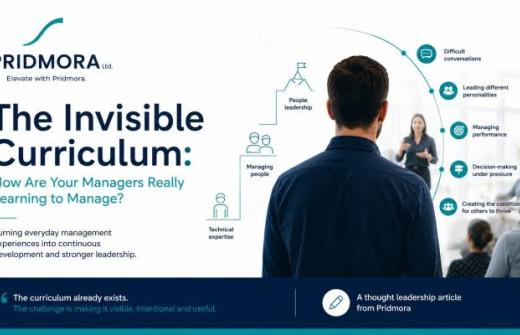
The Invisible Curriculum: How Are Your Managers Really Learning to Manage?
Most organisations would never put someone into a specialist technical role and simply hope they worked out how to do it.
Yet we do something remarkably similar with management.

Remote-first hiring only works when the interview process is structured
Remote-first hiring only works when hiring managers know what to assess, what to ask and what evidence to capture.
Remote-first startups have a clear advantage.

Your values page is not your culture
A startup’s culture is not what it says on the values page. It is what happens when pressure, trade-offs and hiring decisions arrive.
Most startup values sound the same.
Generalists help startups start but specialists help them scale.
Generalists are often the reason a startup gets moving. They are not always the people who can carry every function through scale.
Early startups need generalists.

When leaving feels easier than moving, internal mobility is broken.
If it is easier for someone to get hired by a competitor than move inside their own company, internal mobility is not working.
Large organisations often say they want to retain talent, build career paths and promote from within.

Internal mobility fails when internal interviews feel less fair than external ones.
Internal mobility is not just a retention strategy. It is a trust test.
Growing companies often talk about developing people from within.

Culture does not scale through vibes but through processes.
Process does not kill culture. Weak process lets culture become whatever the loudest person in the room says it is.
Early-stage companies often treat informality as part of their identity.

Fast hiring fails when speed outruns evidence you can trust.
Hiring fast is not the problem. Hiring fast with weak evidence is.
Startups are often told to move quickly, hire quickly and scale before the market moves on.

Scale-ups do not need a harsher talent bar. They need a clearer one.
A high talent bar is not about being harder on candidates. It is about being clearer on what the company actually needs.
Every scale-up says it wants to hire brilliant people.

Scale-ups hire middle managers too late because the signals are unclear
Flat teams feel fast until every decision starts waiting for the same few people.
Startups often begin with a strong dislike of hierarchy.

Technical interviews lose talent when they test the wrong thing
A technical interview should show how someone thinks, builds and works with others. Too many still test how well they perform under artificial pressure.
Technical hiring is one of the hardest parts of scaling a startup.

First hires do not break startups. Unclear hiring evidence does.
Early hiring mistakes rarely look like mistakes at the time. They feel like speed, trust and founder instinct.
In the first stage of a startup, hiring is personal.

SHE Does Safety expands training support for businesses
SHE Does Safety Expands Training Support for Businesses

Why human nature is your biggest security risk
Personal web habits are one of the least visible cybersecurity risks that organisations face – especially when work and personal life share the same devices or browsers.

What we learned from talking to businesses about Microsoft Copilot
Microsoft Copilot is one of the fastest-growing technologies in the Microsoft 365 ecosystem, but many organisations are still asking the same questions.
How does it actually help? Is it ready for everyday use? Where do you start?

Founders cannot scale hiring if every interview depends on them
Founder judgement matters. But if every hiring decision depends on the founder, the company has not built a hiring system yet.
In the earliest stage of a company, founder involvement in hiring is usually necessary.

Candidate ghosting is damaging agency trust. The fix starts before the update email
Candidate ghosting is rarely just a communication problem. It is usually a trust problem that started earlier in the process.
Recruitment agencies know the frustration well.

Subscription recruitment only works if the process earns trust every month
Subscription recruitment is not just a new pricing model. It is a promise to deliver visible value every month.
Recruitment agencies have spent decades operating inside a difficult commercial rhythm.

The simplest way recruitment agencies can build client trust: show clearer interview evidence
Clients do not just want candidates. They want to understand why a candidate is worth their time.
Recruitment agencies build trust in the moments where uncertainty is highest.

Recruitment agencies need evidence, not just advisory language
The modern recruitment agency cannot rely on access alone. Its value has to show up in the quality of the evidence it brings to the hiring decision.
Recruitment agencies are not short of pressure.

Candidate data is not owned. It is borrowed.
Candidate data is not owned by the hiring team. It is borrowed from the person whose career is being discussed.